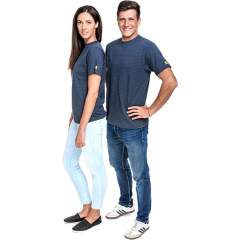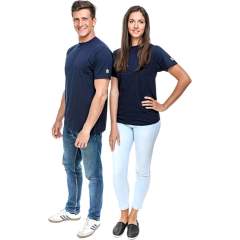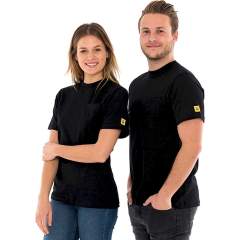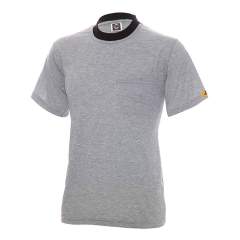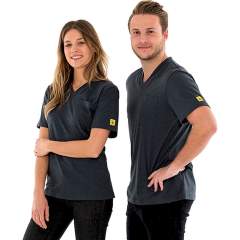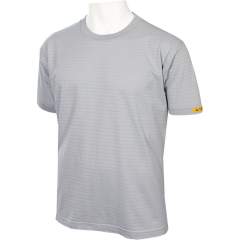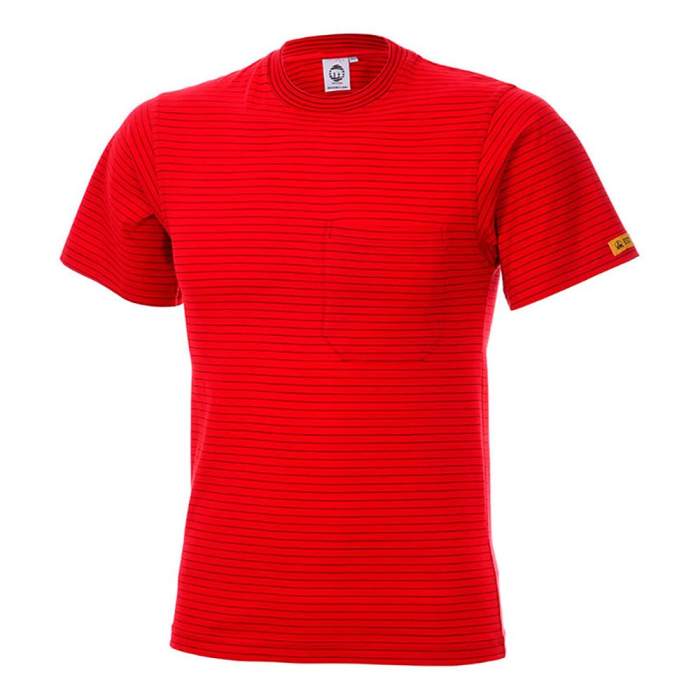
ESD T-Shirt short sleeve red, 150 g/m² compact cotton with conductive yarn - A1-ESD
-
This Item:
As low as €26.18
-
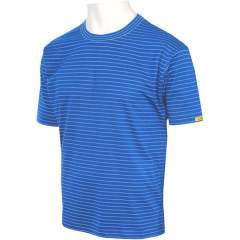
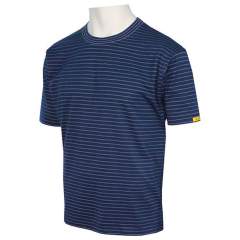
ESD T-Shirt Conductex TS70 Men, short sleeve, knitted, royal blue - HB Schutzbekleidung
€38.67Show details
-
ESD T-shirt, crew neck, chest pocket, royal blue
As low as €25.57Show details
Around 100 volts is enough to damage sensitive semiconductor structures beyond repair. The failure is rarely visible straight away. What usually remains is a latent defect that passes final test and only shows up in the field, and every further step in miniaturisation lowers the threshold.
Personal charge dissipation therefore ranks alongside conductive flooring, ESD footwear, dissipative work surfaces and ionisation. Clothing acts at the source, because it stops the wearer from building up a charge in the first place and drains existing charge through the conductive yarn worked into the fabric.
That is the job of this ESD T-shirt in red. 96 % cotton, 4 % conductive yarn, 150 g/m² fabric weight, and a shade of red that makes single roles readable across the floor.
Your benefits
- 10⁵ to 10⁸ ohm, tested externally: Surface resistance was measured by the STFI test institute to DIN EN 61340-5-1:2016 and sits in the dissipative range. The figure can be shown in an EPA audit instead of relying on a supplier claim.
- Dissipation survives the laundry: The conductive yarn keeps its function across many wash and wear cycles, so a shirt in its third year of service stays in the same resistance window as one taken from a fresh delivery.
- 150 g/m² for a full shift: Combed compact cotton yarn at 150 g/m² stays breathable through eight hours at a soldering bench, whereas heavier synthetic fabrics trap heat and can become a charge source themselves.
- Conductive rib collar: The collar holds its shape and is conductive in itself. At the neckline, where the fabric sits directly against the skin all day, no insulating zone is left in the garment.
- Red marks the role, not the rank: Line marshals, shift leads, quality inspection or escorted visitors can be identified from the far end of a large hall, with no need to read a badge or look for an armband.
- Reactive dyeing keeps the red: Reactive dye bonds chemically to the cotton fibre. The red stays strong across many washes and the batch stays uniform, rather than fading into an uneven pink.
- Twelve sizes from 3XS to 6XL: The range covers a complete shift, from very slim to very large builds. Repeat orders for single sizes ship straight from our own stock without a separate production run.
Lasting dissipation and wash resistance
Surface resistance of the fabric is between 10⁵ and 10⁸ ohm. The measurement was taken by the STFI test institute to DIN EN 61340-5-1:2016 at 23 (+/-1) °C and 25 (+/-5) % relative humidity. That dry test climate is the unfavourable case, because dry air is exactly where clothing charges up most readily. The result therefore sits well inside the dissipative window rather than the insulating one.
The property comes from the conductive yarn worked into the fabric at a 4 % share. High grade silver yarn is processed in a method developed in house. For daily operation the decisive point is that conductivity remains after repeated washing and wearing. A shirt that loses its function after a handful of laundry cycles is worthless in an ESD concept, because nobody notices the loss during a normal shift.
- Surface resistance 10⁵ to 10⁸ ohm
- Tested to DIN EN 61340-5-1:2016 by the STFI institute
- Test climate 23 (+/-1) °C and 25 (+/-5) % relative humidity
- 4 % conductive yarn, dissipation retained over many wash cycles
Material and fabric
The base is combed compact cotton yarn at 150 g/m². Combing removes the short fibres before spinning, leaving long fibres lying in parallel with far fewer fibre ends reaching the surface. The result is a fabric that sheds very little lint and releases correspondingly few particles when work is done on open assemblies.
Ring spun yarn provides the dimensional stability. Shoulder seam and neckline hold their line instead of going slack after the tenth wash. Cotton also charges up less readily than synthetic fabric and picks up odour more slowly, which is noticeable over a full shift in a warm production hall.
- 96 % cotton, 4 % conductive yarn
- Fabric weight 150 g/m²
- Combed compact cotton yarn, ring spun
- Reactively dyed, soft handle
Construction in detail
The crew neck is finished with a conductive rib collar. Rib knit keeps its shape even when the shirt is pulled over the head every day, and the conductive design avoids an insulating patch exactly where the fabric rests permanently against skin. A neck tape covers the inner seam and prevents chafing across the shoulders.
The left chest pocket takes what has to stay within reach at the bench, a test record, a pen or an access card. The ESD logo sits on the left sleeve, where it stays visible while the wearer is seated and the chest is hidden by the workbench. Auditors and visitors can see that the clothing is part of the ESD concept without asking.
- Conductive rib collar on a crew neck
- Neck tape covering the inner seam
- Left chest pocket
- ESD logo on the left sleeve
Fit and size range
Twelve sizes from 3XS to 6XL cover a complete workforce, including the very slim and the very large builds that otherwise have to be sourced separately. The run is 3XS, 2XS, XS, S, M, L, XL, XXL, 3XL, 4XL, 5XL and 6XL. The upper sizes run in the same construction and the same quality as the rest of the range.
The cut is made for movement at the workplace, for reaching forward, working overhead and sitting for long stretches at a placement station. Exact measurements per size are in the size chart, available as a PDF in the Downloads tab, so a collective order can be put together without fittings.
- Sizes 3XS, 2XS, XS, S, M, L, XL, XXL, 3XL, 4XL, 5XL, 6XL
- Straight cut with room to move at the bench
- Size chart as a PDF in the Downloads tab
Red as an identification colour
Red assigns a function without anyone having to step closer. Line marshals, shift leads, quality inspection, floaters or escorted visitors are recognisable across a large hall at a glance, which saves walking and removes a round of questions. In areas where many people wear the same garment, a single red figure on the floor says more than any name card.
The shade comes from reactive dyeing, where the dye forms a chemical bond with the cotton fibre. Red therefore stays strong across many wash cycles and the batch stays consistent instead of fading in patches. One point of classification: this is an in-house identification colour, not high visibility protective clothing.
Technical data
| Type | T-shirt, short sleeve, crew neck |
|---|---|
| Colour | Red |
| Material | 96 % cotton, 4 % conductive yarn |
| Fabric weight | 150 g/m² |
| Yarn | Combed compact cotton yarn, ring spun |
| Dyeing | Reactively dyed |
| Collar | Conductive rib collar |
| Left chest pocket | |
| Features | Neck tape, ESD logo on the left sleeve |
| Surface resistance | 10⁵ to 10⁸ ohm |
| Test standard | DIN EN 61340-5-1:2016 |
| Test institute | STFI |
| Test climate | 23 (+/-1) °C, 25 (+/-5) % relative humidity |
| Decoration | Print up to 160 °C, suitable for embroidery |
| Sizes | 3XS, 2XS, XS, S, M, L, XL, XXL, 3XL, 4XL, 5XL, 6XL |
| Customs tariff number | 6109.1000 |
| Brand | A1-ESD |
Applications
- Placement and assembly lines in electronics manufacturing
- Soldering and rework benches handling open assemblies
- Test, measurement and repair stations inside the EPA
- Semiconductor and assembly stores, picking of sensitive goods
- Training and visitor areas where roles have to stay visible
- Field service work on opened equipment
Care and service life
The T-shirt is suitable for industrial laundering and keeps its dissipative function over many wash cycles. Ring spun yarn and rib collar hold their shape, so the service life pays back over several years. The binding care instructions are printed on the label inside the garment and take precedence over any general recommendation.
Finishing and custom versions
Printable up to 160 °C and suitable for embroidery, with a sample print recommended before a production run. Decoration and special colours outside the catalogue range are produced on request. Further options are sleeves with conductive knitted cuffs, a contrast version and long sleeves with conductive rib cuffs.
Standards and testing
What has been tested is the dissipative behaviour. The STFI institute measured surface resistance to DIN EN 61340-5-1:2016 at 10⁵ to 10⁸ ohm, under 23 (+/-1) °C and 25 (+/-5) % relative humidity. No testing or certification against further ESD standards exists, and no such claim is made for this garment.
| Geschlecht | Unisex |
|---|---|
| Certification | IEC 61340-5-1 |
| ESD version | ESD (antistatic) |
| Manufacturer | A1-ESD |
| Weight | 0.300000 |
| Colour | Red |
| Sales unit | 1 Stück |
| GPSR manufacturer information | A1-ESD equipment GmbH. Keldersstr. 15, DE-42697 Solingen, www.esd.equipment |
| Article authenticity | Original product |
| Condition of article | New |