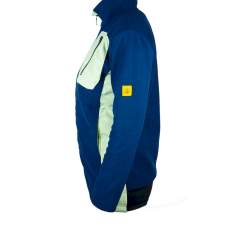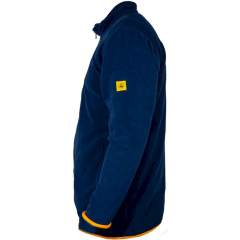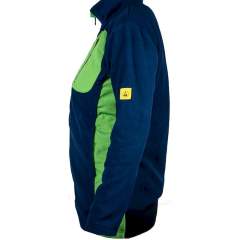

Images are examples, some edited with AI. The technical data are authoritative. AI notice
ESD Ladies Jacket Short Sleeve black, 155 g/m² cotton blend with conductive yarn
Short sleeve ladies jacket for EPA use, made from 155 g/m² compact cotton yarn with polyester and 4 % conductive yarn. Lapel collar, concealed snap placket, patch chest pocket and two side pockets with slanted openings. Black keeps flux and grease marks visually in check, measured surface resistance 10⁵ to 10⁷ ohms.
- Specialist dealer since 2009
- Invoice payment for regular customers
- Worldwide shipping
- Technical questions clarified with the manufacturer
Description
Anyone running a line with sensitive assemblies knows the exposure. Around 100 volts is enough to damage semiconductor structures for good, and the failure often shows up at the customer rather than in final test. Dissipative flooring, tested work surfaces and ionisation cover part of the path. Clothing is the part that stays next to the component for the whole shift.
This short sleeve ladies jacket is built for that position. It weighs 155 g/m², goes over a shirt or blouse and leaves the forearms free, which works more cleanly at a soldering bench than a long sleeve dragged across the tray. The 4 % conductive yarn runs as a grid through the entire cut and carries charge away instead of letting it sit on the surface.
Black is the pragmatic choice here. Flux residue, solder paste, grease and toner dust show up far less, so the jacket still looks presentable at the end of the week.
Your benefits
- 4 % conductive yarn, not a coating: The conductive thread is woven in rather than applied on top. Measured surface resistance is 10⁵ to 10⁷ ohms, which places the fabric firmly in the dissipative range instead of the insulating one.
- 155 g/m² across a full shift: Light enough that nothing builds up at a warm rework bench, heavy enough that the jacket keeps its shape and hangs properly after eight hours of movement.
- Short sleeve at the soldering bench: A free forearm does not drag across boards, flux residue or hot rests, and nothing catches on the fume extraction arm or the microscope stage.
- Concealed snap placket: The snaps sit under a fabric flap. Leaning over a component tray brings no exposed metal into contact with the assembly or with a painted housing.
- ESD logo on the right pocket: During an EPA walkthrough it is visible from the front that the wearer has dissipative clothing on. Nobody has to look for a sewn-in label at the collar.
- Low lint around open assemblies: Compact spun cotton binds protruding fibre ends into the yarn and sheds very little. That reduces cleaning effort on optics, contacts and test adapters.
- Made for industrial laundering: The jacket is intended for commercial processing, and the conductive yarn keeps its conductivity through repeated washing and wear.
Fabric and material
The fabric combines 48 % cotton, 48 % polyester and 4 % conductive yarn at 155 g/m². The cotton is compact spun, so protruding fibre ends stay bound inside the yarn. That is where the low lint behaviour comes from, and it is what matters around open assemblies and under a microscope. The polyester share does the shape holding, so shoulders and collar come back from the laundry as they went in.
For the conductive component we use high grade silver yarn in a process developed in house. The operational point is simpler: conductivity sits in the yarn, not in a finish that can wash out over time. That distinction decides whether a garment still measures within specification in its second year of service or quietly stops working.
- 48 % cotton for hand feel, moisture transport and low lint
- 48 % polyester for shape retention, drying behaviour and service life
- 4 % conductive yarn as a continuous grid through the whole cut
- 155 g/m² fabric weight, wearable over a shirt all year round
Construction in detail
The lapel collar leaves the neckline open and gives the jacket a line that also works in a customer or audit conversation. A sweat guard sits at the nape, an extra layer of fabric exactly where long shifts soak through first. Bust darts at the sides shape the front panels, so the jacket does not gape open when the wearer leans over the bench.
Pocket layout follows the tools of someone who moves between workstations. A patch chest pocket on the left takes a pen, a travelling card or a small meter, and two side pockets with slanted openings stay reachable while standing with the arm bent. The ESD logo sits on the right side pocket.
- Lapel collar, worn open
- Concealed snap fastener placket with no exposed metal
- Patch chest pocket on the left
- Two side pockets with slanted openings
- Sweat guard at the nape and bust darts at the sides
- ESD logo on the right side pocket
Dissipation that survives the laundry
Dissipative clothing is only worth what it measures after the fiftieth wash. Because the conductive yarn is part of the weave, the jacket does not lose its function through a surface treatment wearing away. The conductive yarn retains its conductivity through repeated washing and wear.
In practice that means a service life you can plan, rather than replacing garments on a hunch. If you spot check clothing as part of your EPA routine, you are recording a value that stays stable across the useful life, so nothing has to be swapped out early as a precaution. That pays off wherever several sets per employee circulate and the laundry runs weekly.
Fit and size range
The ladies jacket is available in twelve sizes from 3XS to 6XL. That covers a full shift without putting anyone into a unisex cut that sits badly across shoulder and bust. Exact measurements are listed in the size chart, available as a PDF in the downloads tab of this product page.
Large sizes are part of the standard range, which makes sure the last colleague on the list also gets a garment that closes properly instead of being worn open at the bench. Smaller quantities ship directly from our warehouse.
Why black on the shop floor
Black is the colour for benches where the fabric takes a hit. At soldering and rework stations flux, solder paste and cleaning agents end up on the cuff area, and in printer logistics fine black dust joins in. All of it registers far less on dark fabric than on light.
Reactive dyeing anchors the shade in the cotton fibre rather than laying it on the surface. The jacket stays properly black through many commercial wash cycles instead of fading to a tired grey that undercuts how the team looks to visitors. Where a department reorders over several years, the new delivery still matches the garments already in circulation.
Applications
- Soldering and rework benches with flux and solder paste
- Manual placement and touch-up work on printed circuit boards
- Test and repair stations with adapters and measuring equipment
- Assembly and semiconductor stores with frequent handling
- Field service work where the jacket doubles as customer facing wear
- Toner and printer logistics inside an EPA
Care and service life
The jacket is suitable for commercial industrial laundering and is built to go through many processing cycles. The polyester share holds shoulders and collar in shape, and the woven-in conductive yarn keeps its conductivity through repeated washing and wear. Temperature and process are governed by the care label inside the garment.
Finishing and custom versions
The jacket takes embroidery and print up to 160 °C, with a sample print recommended beforehand. Company logo, department or name can go on the chest pocket or the back. Snap fasteners and pockets can be supplied in a contrast colour on request, as can special colours and finishes outside the catalogue. Talk to us for a quotation.
Standards and testing
The jacket passed testing for dissipative behaviour and surface resistance to DIN EN 61340-5-1:2016 at the STFI test institute. The measured value is 10⁵ to 10⁷ ohms in a test climate of 23 (+/-1) °C and 25 (+/-5) % relative humidity. No testing or certification against further ESD standards has taken place so far, and none is claimed here.
Technical data
| Style | Ladies jacket, short sleeve, lapel collar |
|---|---|
| Colour | Black |
| Material composition | 48 % cotton, 48 % polyester, 4 % conductive yarn |
| Fabric weight | 155 g/m² |
| Surface resistance | 10⁵ to 10⁷ ohms |
| Test climate | 23 (+/-1) °C, 25 (+/-5) % relative humidity |
| Test basis | DIN EN 61340-5-1:2016 |
| Test institute | STFI |
| Fastening | Concealed snap fastener placket |
| Pockets | Patch chest pocket left, two side pockets with slanted openings |
| Further details | Sweat guard at the nape, bust darts at the sides |
| ESD logo | On the right side pocket |
| Decoration | Printable up to 160 °C, suitable for embroidery |
| Care | Suitable for industrial laundering |
| Sizes | 3XS, 2XS, XS, S, M, L, XL, XXL, 3XL, 4XL, 5XL, 6XL |
| Customs tariff number | 6203.3310 |
| Brand | A1-ESD |
| Weight | 0.1 kg |
| Manufacturer | A1-ESD |
| GPSR manufacturer information | A1-ESD equipment GmbH. Keldersstr. 15, DE-42697 Solingen, www.esd.equipment |
| Condition of article | New |
| Article authenticity | Original product |
| Sales unit | 1 Stück |
| ESD version | ESD (antistatic) |
| Geschlecht | Women |
| Certification | IEC 61340-5-1 |
Downloads
Datasheet
Other
Questions about this item
Any other question?
Send us the item number and your question. We clarify technical details directly with the manufacturer and usually reply on the next working day.