Safeguard
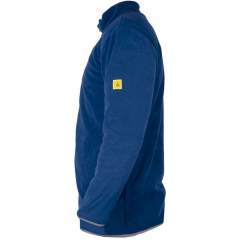
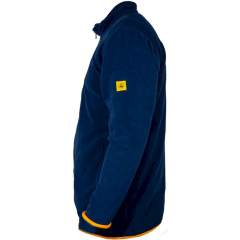
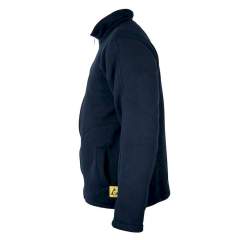
ESD fleece jacket unisex with long zip, navy blue/light blue
Item SG-0057
As low as
€102.38
Images are examples, some edited with AI. The technical data are authoritative. AI notice
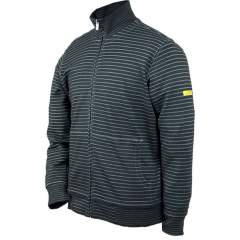
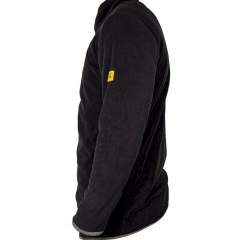
This black long-sleeve men's jacket weighs 155 g/m² and combines 48 % cotton with 48 % polyester and 4 % conductive yarn. A concealed snap placket, a sweat guard at the neck and snap-adjusted sleeve width carry it through a full shift. Measured surface resistance is 10⁵ to 10⁷ ohms.
Anyone equipping a rework or repair bench needs a jacket that stays on for eight hours without becoming a problem of its own. Flux residue and solder paste barely show on dark fabric, while the dissipative behaviour has to remain measurable. The black version is built around exactly that pair of demands.
The fabric weighs 155 g/m² and is made of 48 % cotton, 48 % polyester and 4 % conductive yarn. Cotton absorbs moisture and stays lint-free, polyester keeps front edges and sleeves in shape. The conductive yarn is woven into the cloth and therefore works across the whole surface of the garment, not only along a few seams.
Testing followed DIN EN 61340-5-1:2016 at the STFI institute and produced a surface resistance of 10⁵ to 10⁷ ohms. That places the jacket in the range an EPA concept expects from personnel-related dissipation.
The split of 48 % cotton, 48 % polyester and 4 % conductive yarn is a deliberate division of labour. Cotton handles moisture and gives the cloth a soft hand against the skin, polyester supplies dimensional stability so that front edges and cuffs do not go slack after many washes. At 155 g/m² the jacket stays light enough to be worn over ordinary clothing.
Compact cotton yarn is spun tighter than standard yarn, which leaves fewer fibre ends standing out of the yarn surface. The cloth barely pills and releases few particles into the room. On optical inspection benches and in placement that matters directly, because a single fibre on a lens or on freshly printed solder paste means rework.
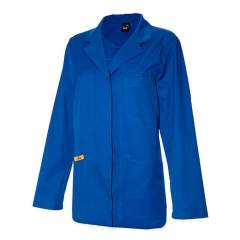
The notched lapel collar gives the jacket a line that holds up in front of customers and auditors. It closes with a concealed snap placket, the snaps sitting behind the cloth. Nothing hard is left along the front edge that could scratch an assembly or a painted enclosure surface.
A patch chest pocket on the left takes a pen, a test record or a works ID. Two side pockets with slanted openings follow, and the angle means the hand finds them even while seated at a bench. The ESD logo is placed on the right side pocket, where it stays visible during normal work instead of hiding inside a collar label.
Dissipative clothing is worth only as much as its condition after many wash cycles. Applied finishes lose their effect over time. Here conductivity belongs to the yarn construction, the conductive yarn is woven in and cannot be washed out. High-grade silver yarn is processed in a method developed in house.
The measured surface resistance is 10⁵ to 10⁷ ohms, recorded at the STFI institute at 23 (+/-1) °C and 25 (+/-5) % relative humidity. That low humidity is the demanding case, because dry air encourages charging. In an air-conditioned production area the jacket is therefore not working at the edge of its measured range.
The jacket runs from 3XS to 6XL, twelve sizes from a single cut. A whole shift can be dressed without putting anyone into a garment that is clearly too large. Loose clothing catches on tool trolleys, rides up over the wrist strap and gets in the way during placement work, so the size range is a practical argument rather than a catalogue figure.
Exact measurements per size are listed in the size chart, available as a PDF in the Downloads tab of this product page. Before a larger first order, a sample set in two or three sizes is worth the effort. Anyone kitting out a whole department should include the outer sizes from the start, so that single items do not have to be chased later.
Black is the pragmatic choice wherever something sticks. Flux residue, solder paste, contact grease and toner dust leave visible rings on pale cloth and stay unnoticed far longer on a dark ground. For rework, service and printer maintenance that means longer wearing cycles between washes and fewer arguments about when a jacket needs replacing.
The jacket is built for industrial laundering. The polyester share keeps collar, cuffs and front edges in shape, so the snap placket still closes cleanly after many cycles. Conductivity survives many wash cycles because it sits in the yarn rather than in a coating. Binding washing instructions are printed on the care label inside the garment.
Embroidery and printing are carried out in Germany. The fabric takes print up to 160 °C and suits embroidery, with a sample print recommended first. Available on request: a conductive rib cuff at the sleeve, additional snap fasteners or pockets, and a contrast version. Special colours outside the catalogue range are quoted on request as well.
The jacket was tested for dissipative behaviour and surface resistance in line with DIN EN 61340-5-1:2016. The test institute is the STFI, and the measured value is 10⁵ to 10⁷ ohms at 23 (+/-1) °C and 25 (+/-5) % relative humidity. No testing or certification to further ESD standards has taken place.
| Style | men's jacket, long sleeve, notched lapel collar |
|---|---|
| Colour | Black |
| Material | 48 % cotton, 48 % polyester, 4 % conductive yarn |
| Fabric weight | 155 g/m² |
| Surface resistance | 10⁵ to 10⁷ ohms |
| Test standard | DIN EN 61340-5-1:2016 |
| Test institute | STFI |
| Test climate | 23 (+/-1) °C, 25 (+/-5) % relative humidity |
| Closure | concealed snap placket |
| Pockets | chest pocket left, two side pockets with slanted openings |
| Sleeves | long, width adjustable by snap fasteners |
| Neck | sweat guard |
| ESD logo | on the right side pocket |
| Decoration | printable up to 160 °C, suitable for embroidery |
| Sizes | 3XS, 2XS, XS, S, M, L, XL, XXL, 3XL, 4XL, 5XL, 6XL |
| Customs tariff number | 6203.3310 |
| Brand | A1-ESD |
| Weight | 0.1 kg |
| Manufacturer | A1-ESD |
| GPSR manufacturer information | A1-ESD equipment GmbH. Keldersstr. 15, DE-42697 Solingen, www.esd.equipment |
| Condition of article | New |
| Article authenticity | Original product |
| Sales unit | 1 Stück |
| ESD version | ESD (antistatic) |
| Geschlecht | Men |
| Certification | IEC 61340-5-1 |
Send us the item number and your question. We clarify technical details directly with the manufacturer and usually reply on the next working day.