
How to choose an AOI system - what really matters?
An AOI system automatically inspects assembled PCBs for placement and solder defects. This guide explains the four decisive selection criteria: camera resolution, throughput, inline vs offline and the defect library - so your inspection matches your batch size and assembly.
View soldering guidesContents
How much camera resolution does your board need?
Resolution decides how small a defect can be and still be reliably detected. It is given as the pixel size on the board, usually between 7 and 18 µm per pixel. A finer grid lets you judge smaller parts and solder joints, but it also shrinks the field of view per image.
As a rule of thumb, several pixels should fall on the smallest feature you inspect. For 0402 and 0201 parts 15 µm is often enough, while 01005 chips and fine-pitch BGA call for 10 µm or finer. Excessive resolution costs throughput and storage without adding real inspection value.
How do throughput and batch size relate?
Throughput describes how fast the system inspects a board, given in cm² per second or in boards per hour. It depends directly on the chosen resolution, the number of fields of view and the computing power. Higher resolution means more image fields and therefore longer inspection time.
In high-volume production the AOI time must stay below the line takt, otherwise the system becomes the bottleneck. For prototypes and small runs throughput matters less, while fast programming and easy changeover count for more.
- Volume production: inspection time must be shorter than the placement and reflow takt.
- Small runs and prototypes: flexible programming beats a few seconds.
- Large panels benefit from few, large fields of view.
- Angled or side cameras add coverage but cost takt time.
Inline or offline - which concept fits?
An inline AOI is built into the SMT line via conveyor and inspects every assembly automatically at line takt. An offline or benchtop unit is loaded manually and suits sampling, rework stations and flexible production with frequent product changes.
Inline gives 100 percent inspection and direct feedback to placement, but needs floor space, SMEMA connection and a larger budget. Offline is cheaper and mobile, yet shifts handling and cycle time onto the operator.
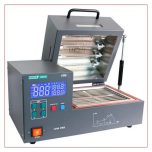 Reflow and solder profile
Many defects originate in reflow - learn to judge solder joints correctly.
Read the guideWhy is the defect library so important?
The defect library is the collection of failure patterns and algorithms the AOI uses to tell good from bad. A rich, well-maintained library reliably detects tombstones, solder bridges, missing or rotated parts and insufficient wetting - with as few false calls as possible.
What matters is the balance between escapes and false calls. A system that flags every doubt overloads rework; one that is too tolerant lets real defects through. Modern systems combine rule-based inspection with AI-assisted classification to cut the false-call rate.
- Missing, shifted or rotated parts (placement defects).
- Tombstoning and lifted components.
- Solder bridges, solder balls and insufficient wetting.
- Polarity and text OCR checks on components.
- Assessment to IPC-A-610 class 2 or 3.
Frequently asked questions
What is the minimum camera resolution for AOI?
For standard placement with 0402 and 0201 parts about 12 to 15 µm per pixel is enough. For 01005 chips and fine-pitch BGA aim for 8 to 10 µm or finer so that several pixels fall on the smallest feature.
Inline or offline AOI - which is better?
Inline inspects every board 100 percent in the volume line and feeds trends straight back. Offline is cheaper and flexible for sampling, prototypes and rework. The choice depends on volume and how often products change.
What makes a good defect library?
It reliably detects real defects such as tombstones, solder bridges and missing parts while producing few false calls. Easy teaching from CAD data and assessment to IPC-A-610 are key.
Which standard is used to judge solder joints?
IPC-A-610 with classes 1 to 3 is common. Industrial and safety electronics usually require class 2 or 3. The AOI program should reflect the matching acceptance criteria.
Looking for the right AOI system?
We supply solder inspection systems with a range of resolution, throughput and inline or offline concepts, matched to your assembly and batch size.
Standards-based
Assessment to IPC-A-610 class 2 and 3.
Few false calls
A curated defect library, not an alarm flood.
Right takt
Throughput matched to your line and batch size.
Selection help
We help you choose the right products; technical details are clarified with the manufacturer.