
How to size a solder fume extractor correctly
Solder fumes contain rosin aerosols and flux vapours that irritate the airways. This guide explains how to size a solder fume extractor by airflow in m³/h, filter stages and workspace size.
View solder fume extractorsContents
Why are solder fumes hazardous?
During soft soldering the flux evaporates and forms a fine fume of rosin particles and gaseous decomposition products. These aerosols sit in the respirable range below 1 µm and can irritate the airways and the conjunctiva. Rosin (colophony) is a recognised respiratory sensitiser and can trigger asthma.
The fume rises with thermal lift straight into the breathing zone of the person soldering. Without extraction the contaminants accumulate in the room air and burden the whole workplace. Effective extraction therefore captures the fume right at the tip before it reaches the breathing zone.
- Rosin acts as a sensitiser and can cause occupational asthma.
- Aldehydes and isocyanates form during thermal decomposition.
- Fine particles below 1 µm are respirable and reach deep into the lungs.
- Lead-free soldering at higher temperatures produces more fume.
How much airflow do you need?
What matters is the capture velocity at the fume source, not the maximum fan rating. At the extraction nozzle you should have at least 0.5 m/s so the rising fume is drawn in reliably. From that follows the required volume flow, depending on the distance between nozzle and joint.
For a single workstation with the nozzle close to the joint, 80 to 100 m³/h is usually enough. The further away the nozzle sits, the higher the volume flow must be, because capture velocity falls with the square of the distance. Multi-station systems add up the demand of every connected arm.
Which filter stages are required?
An effective solder fume extractor works in multiple stages. A pre-filter catches coarse particles and spatter, a HEPA H13 particulate filter captures at least 99.95 % of the fine particles, and an activated carbon filter binds the gaseous fraction and odours.
- Pre-filter (G3/G4): protects the downstream filters from coarse particles.
- HEPA H13/H14: removes respirable aerosols at 99.95‑99.995 %.
- Activated carbon: adsorbs organic gases, aldehydes and odours.
- Combi cartridge: HEPA and carbon in one replaceable unit.
Recirculating units return the cleaned air to the room and therefore require both particle and gas filters. Only then may you work without a duct to the outside. A filter change indicator flags saturated filters in time, before capture efficiency drops.
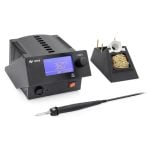 Choose a soldering station
The right station and temperature reduce the amount of fume produced.
View productsHow do you set up the workstation?
The unit size follows the number of stations and the space available. On an ESD workstation the extractor itself must be dissipative so it introduces no charge. Articulated extraction arms position flexibly and hold the nozzle close above the joint.
The DIN EN ISO 21904 series sets requirements and test methods for equipment that captures and separates welding and solder fume. It defines capture efficiency, separation classes and testing of extraction arms. Also aim for quiet operation below about 55 dB(A), so the unit stays switched on all day.
Frequently asked questions
How much m³/h does a soldering station need?
For a single station with the nozzle close to the joint, 80 to 100 m³/h is usually enough. The decisive factor is a capture velocity of at least 0.5 m/s at the extraction opening.
Is a HEPA filter enough for solder fume?
No. HEPA H13 captures the fine particles but binds no gases. For recirculating operation you also need an activated carbon filter that adsorbs the gaseous flux fraction and odours.
When do the filters need replacing?
The pre-filter as it gets dirty, the HEPA filter usually after 6 to 12 months, and the carbon by the maker's interval or at odour breakthrough. A change indicator helps you monitor this.
Does an ESD extractor need a special design?
Yes. In an ESD area the housing must be dissipative so the extractor introduces no static charge. Standard units made of insulating plastic are not permitted here.
Looking for the right solder fume extractor?
We supply single- and multi-station extractors with HEPA and activated carbon filters, ESD-suitable and tested to DIN EN ISO 21904.
Standard-tested
Units to DIN EN ISO 21904 with defined capture efficiency.
Effective capture
0.5 m/s at the nozzle pulls fume out of the breathing zone.
Multi-stage filters
HEPA H13 plus activated carbon for particles and gases.
Selection help
We help you choose the right products; technical details are clarified with the manufacturer.