
Condensation or Desiccant Dehumidifier - Which One Wins?
Condensation and desiccant dehumidifiers work on completely different physics, and each has its temperature sweet spot. This guide shows which principle gives you the better drying performance at a given room temperature and target humidity in storage, workshop and plant rooms.
To the guidesHow do the two principles differ?
A condensation dehumidifier draws room air over a cold evaporator coil where the water vapour condenses into droplets that drain into the tank or a hose. A desiccant dehumidifier instead uses a rotating silica-gel wheel that chemically binds the moisture and releases it again into a heated regeneration airflow.
The decisive difference is their dependence on temperature. Condensation technology needs warm, humid air so that dew can actually form on the cold coil. Desiccant technology also works in the cold, because the silica gel absorbs water vapour regardless of the dew point.
- Condensation: compressor, evaporator, fan - high output when it is warm.
- Desiccant: sorption wheel plus heater - steady even in the cold.
- Both lower relative humidity, but by completely different routes.
Which unit at which room temperature?
The output of a condensation drier is quoted at 30 °C and 80 % relative humidity and drops sharply as the temperature falls. At 10 °C the same unit often delivers only a third of its rated capacity, and below freezing the evaporator risks icing up.
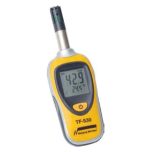 Measuring humidity
How to use a hygrometer to set the right target humidity for your room.
View productsStorage, workshop or plant room - what counts?
The use case matters too. In a heated workshop or plant room at 18 to 24 °C the condensation drier is usually ideal, because it runs cheaply and drains the condensate directly. An unheated store, a cellar archive or a winter drying site, by contrast, call for the desiccant unit.
- Heated plant room (20‑24 °C): condensation drier with humidistat and permanent drain.
- Workshop with roller door (fluctuating 10‑22 °C): condensation with hot-gas defrost.
- Unheated store or archive (2‑12 °C): desiccant drier for a steady 50 % RH.
- Material store with metal or electronics: target 45‑50 % against corrosion.
- Winter building site below 5 °C: only desiccant reaches the drying limit.
Also plan the exhaust routing of a desiccant drier: the moist regeneration air must be ducted outside, otherwise the water stays in the room. Condensation driers need no such exhaust hose, but they do require a frost-free drain or tank emptying.
Frequently asked questions
Condensation or desiccant dehumidifier - which is more efficient?
At room temperatures above 15 °C the condensation drier uses noticeably less electricity per litre of water removed. Below 10 °C this reverses, because the condensation drier barely separates any water while the desiccant drier keeps working steadily.
What target humidity should I set?
For storage, workshop and plant rooms, 45 to 55 % relative humidity is a good compromise between corrosion protection and material care. For metal and electronics aim closer to 45 to 50 %.
Why does my condensation drier ice up in a cold store?
Below about 10 °C the evaporator temperature drops under freezing and the moisture freezes instead of dripping off. Hot-gas defrost units ease this, but below 5 °C a desiccant drier is the better choice.
Does a desiccant drier need to exhaust outside?
Yes. The sorption wheel releases the bound moisture into a warm regeneration airflow that must be ducted outdoors through a hose. Otherwise the water simply returns into the room.
Not sure which principle you need?
Our guide explains condensation and desiccant dehumidifiers for every room temperature, plus the right capacity and target humidity.
For any temperature
Units for warm and freezing rooms alike in stock.
Verified output
Ratings stated at the standard 30 °C / 80 % RH.
Target humidity held
Humidistat keeps 45-55 % RH stable.
Selection help
We help you choose the right products; technical details are clarified with the manufacturer.