
Equipping an ESD Protected Area (EPA): What Belongs In It?
An ESD Protected Area (EPA, Electrostatic Protected Area) reliably protects sensitive electronics only when all elements work together: personnel grounding, dissipative surfaces and floors, grounded storage, ionisation and regular verification. This article shows which equipment makes up a compliant EPA in accordance with DIN EN 61340-5-1.
To the guidesContents
What is an ESD Protected Area (EPA)?
An EPA (Electrostatic Protected Area) is a spatially defined zone in which electrostatic discharge sensitive devices (ESDS) are handled safely. All conductive and dissipative elements - people, work surfaces, floor and equipment - are connected to a common ground potential through defined resistances. This way, no damaging potential differences can arise.
In everyday use, charges are generated mainly by the friction and separation of materials (triboelectric charging). Under the current ESD standards, the maximum permissible charge in the protected area follows the Human Body Model, with 100 V as the reference value. Electrostatic protected areas and individual ESD workstations are therefore required in almost all electronics and semiconductor manufacturing.
Personnel grounding: wrist, footwear, chair
People are the largest source of charge in the EPA. Walking on an insulating floor, a person can charge up to several kilovolts. That is why every person is connected to ground in a controlled way - depending on the activity, via the wrist, via the footwear or via both.
 Wrist strap
Defined dissipative connection to ground for seated activities, usually through 1 MΩ.
To the rangeFootwear and heel groundingFor standing and mobile activities - effective only together with a dissipative floor.
To the rangeESD chairMinimises charging when standing up and additionally grounds the person during seated activities.
To the rangeESD clothingDissipative, closed clothing shields the electrostatic fields of the garments worn underneath.
To the rangeDissipative surfaces, floor and grounding
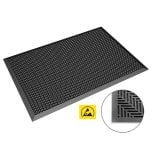
In addition to the person, all work and storage surfaces must also dissipate charge in a controlled way. They are connected to the protective earth in a star configuration via a common grounding point.
A groundable work surface dissipates charge from components and tools in a controlled way.
A central grounding point bundles bench, mat and personnel grounding with defined resistances.
Shelving units and storage racks are grounded so that transport systems retain their dissipative properties.
Ionisers neutralise charge on insulators that are unavoidable for process reasons.
The EPA at a glance
The following overview shows a fully equipped ESD protected area - from zone marking at the entrance, through personnel and surface grounding, to storage, tools and test equipment.
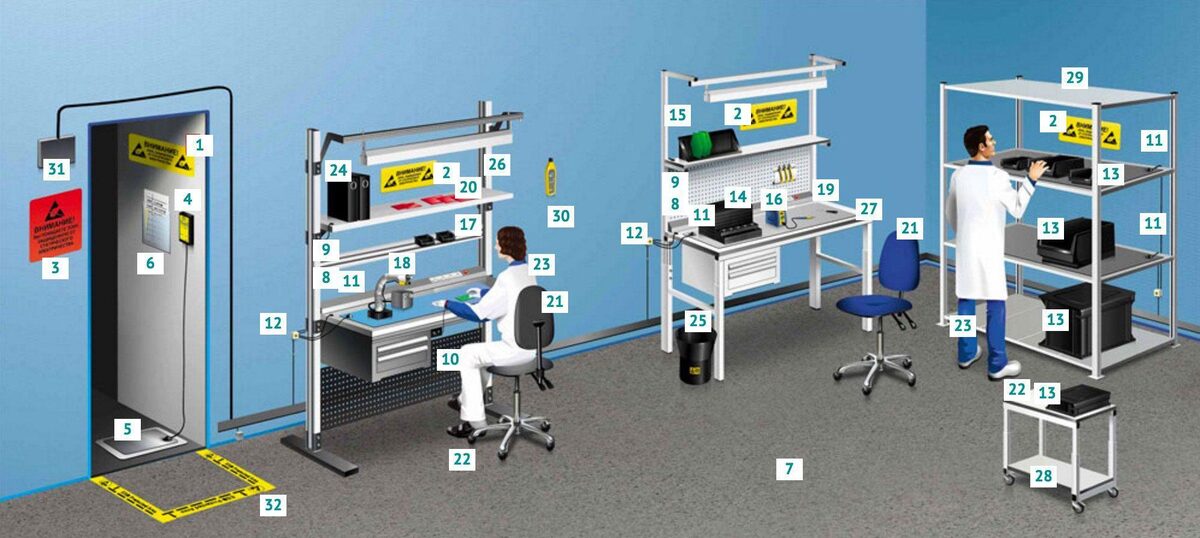
Marking of the EPA entrance, work zone and exit, plus zone marking tape on the floor.
Personnel grounding tester, footwear tester plate and test log for periodic verification.
Dissipative storage magazines, SMD cabinets and ESD packaging (conductive, dissipative, shielding).
ESD tools, an ESD soldering station, PCB holders and ESD gloves.
Antistatic, dissipative or conductive?
Floor coverings differ in their electrical resistance and therefore in their level of protection. Which version is needed depends on the application.
| Type | Application | Bonding and grounding |
|---|---|---|
| Antistatic | Offices with IT equipment - distributes charges over a large area and prevents disruptive discharges. | without conductive adhesive |
| Electrostatic dissipative | Assembly and maintenance of electronics, medical areas - dissipates even the smallest charges in a controlled way. | conductive adhesive, grounding via copper tape |
| Electrically conductive | Explosive atmospheres such as operating theatres, laboratories or ammunition depots - prevents spark discharge. | conductive adhesive, additional copper tape grid |
Where humidity is frequently low (below 25 %) or the substrate is strongly insulating, such as mastic asphalt, the use of conductive adhesive is recommended even for antistatic coverings.
Handling rules for ESDS
Even the best equipment only works with the right handling rules. The following basic rules apply to processing electrostatic discharge sensitive devices (ESDS):
Process ESDS exclusively at electrostatic protected workstations.
Ensure personnel grounding via the wrist and footwear, and pay attention to gentle potential equalisation.
Keep chargeable materials such as ordinary PE, PVC or polystyrene foam out of the zone.
Use only marked, tested ESD packaging and transport materials.
Do not expose ESDS to electrostatic fields above 100 V/cm.
Train staff regularly on ESD fundamentals and handling.
Frequently asked questions
What belongs to the basic equipment of an EPA?
At minimum: personnel grounding (wrist strap or footwear grounding), a dissipative work surface with grounding, a dissipative floor, a common grounding point, and ESD packaging for storage and transport. Test equipment and marking are added to this.
Why exactly 1 megohm in the grounding path?
A resistance of around 1 MΩ dissipates charge safely while at the same time limiting the discharge current to a level that is harmless to people and components. It is a compromise between dissipation and current limiting.
Is a dissipative floor enough without footwear grounding?
No. The floor only works together with footwear or heel grounding that connects the person conductively to the floor. Without suitable personnel grounding, the charge remains.
How often must the EPA be tested?
Personnel grounding is tested every working day; surfaces, floors and grounding points are tested periodically according to the ESD control plan. The results belong in the test log for the audit.
Equip your ESD protected area to standard
Wrist straps, mats, floors, grounding boxes, ionisers, test equipment and packaging - compliant with DIN EN 61340-5-1. Our guides explain how the pieces fit together.
Standard-compliant
Products and recommendations in accordance with DIN EN 61340-5-1.
Reviewed
Content professionally reviewed by ESD specialists.
Complete range
Over 200 brands for the ESD workstation.
Selection help
We help you choose the right products; technical details are clarified with the manufacturer.