
How to Choose Hydraulic Oil: HLP, VI and Temperature
The right hydraulic oil determines efficiency, service life and protection of the system. This guide explains the HLP classes under DIN 51524, the ISO VG viscosity grades, the viscosity index and how to match the oil to your operating temperature.
To the guidesWhat do HL, HLP and HVLP mean?
Hydraulic oils are split into three groups in DIN 51524. HL provides anti-oxidation and corrosion protection, HLP adds anti-wear additives (AW), and HVLP also contains a VI improver for a wide temperature window.
For most stationary industrial systems, HLP is the standard because the anti-wear package protects pumps and valves. HVLP is chosen when the system sees large temperature swings, for example mobile hydraulics used outdoors.
How do you pick the right ISO VG grade?
The ISO VG grade states the kinematic viscosity in mm²/s (cSt) at 40 °C. ISO VG 46 means roughly 46 mm²/s at 40 °C, within a tolerance of plus/minus 10 percent. The pump manufacturer's specification always takes priority.
- ISO VG 32: light vane and gear pumps, cooler environment.
- ISO VG 46: the most common all-round value for industrial hydraulics.
- ISO VG 68: high loads, warm environment, axial piston pumps.
- Too thin: leakage and wear rise, the lubricating film breaks.
- Too thick: cold-start problems, cavitation and higher losses.
The viscosity index (VI) describes how strongly viscosity changes with temperature. A high VI means a flatter curve: the oil is not too thick when cold and not too thin when hot. Standard HLP sits at VI 90 to 100, while HVLP multigrade oils reach VI 140 and above.
How do you match the oil to operating temperature?
What matters is not the ambient temperature but the stable oil temperature in the tank, usually 40 to 60 °C. From this temperature and the pump's permissible viscosity window you choose the ISO VG grade.
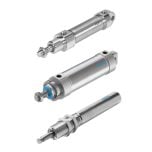 Pneumatics & Hydraulics
Matching oils, filters and accessories for your system at a glance.
View productsFrequently asked questions
What does the number in HLP 46 mean?
The 46 is the ISO VG viscosity grade, roughly 46 mm²/s at 40 °C. HLP describes the oil type with anti-wear additives; the number only states the viscosity.
Can I replace HLP with HVLP?
Usually yes, if the viscosity grade is the same. HVLP has a higher viscosity index and performs better under strongly varying temperatures. Always check the manufacturer's approval.
What happens with the wrong viscosity?
Oil that is too thin causes leakage, wear and a breaking lubricating film. Oil that is too thick causes cold-start problems, cavitation and energy losses through internal friction.
How often should hydraulic oil be changed?
It depends on temperature, load and cleanliness. Typical intervals are 2000 to 4000 operating hours; high oil temperatures shorten them significantly. Oil analysis gives certainty.
Looking for the right hydraulic oil?
HLP and HVLP oils come in all common ISO VG grades to DIN 51524 - more in our guides.
Standard compliant
Oils to DIN 51524 for HLP and HVLP.
All ISO VG grades
From VG 32 to VG 68 in stock.
Proven quality
Anti-wear protection and a stable film.
Selection help
We help you choose the right products; technical details are clarified with the manufacturer.