
How to choose the right anti-fatigue mat for standing work
Anti-fatigue mats relieve the back, legs and joints at standing workstations because the soft surface prompts constant micro-movements of the muscles. This guide explains how to choose cushioning and thickness, the edge profile and resistance to oil or static charge.
View anti-fatigue matsWhy do anti-fatigue mats relieve the body?
Standing on a hard floor for hours puts a static load on veins, joints and the spine. An anti-fatigue mat gives slightly, so the leg and core muscles make constant small balancing movements. These micro-movements keep the blood flowing and noticeably delay fatigue.
Studies on standing work show that good cushioning clearly reduces discomfort in the legs and lower back. The effect depends directly on the right material and thickness - a mat that is too soft or too hard misses the point.
What cushioning and thickness make sense?
The key is the ratio of thickness to firmness. Common mats range from 9 to 20 mm; PU foam springs back elastically over the long term, while closed-cell nitrile foam is more robust against oil. Mats that are too soft feel unstable and also tire you, because the body has to compensate too much.
- Light standing work: 9‑14 mm PU foam is usually enough.
- Heavy or full-day standing work: 15‑20 mm for more reserve.
- Rolling loads (pallet truck, chair) need a firm, pressure-stable mat.
- Avoid mats that are too soft - they tilt the foot and increase strain.
Edge profile and resistance - what is essential?
The edge decides safety. A shallow bevelled edge of around 20° prevents trips and lets carts roll on cleanly. Just as important is resistance to the substances at the workstation - oil, grease, cutting fluids or cleaners attack unsuitable foams and make them harden.
- Bevelled edges (approx. 20°) on all sides against trips.
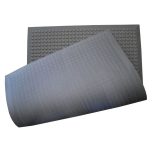
- Studded or perforated surface improves grip and lets liquid drain.
- Oil and grease resistant NBR mats for machining and kitchens.
- Anti-slip underside so the mat does not wander.
- Check chemical resistance where solvents are involved.
At ESD workstations with electronic components you also need a conductive mat. It drains static charges to an earth point in a controlled way and sits in the 10⁶ to 10⁹ Ω range, keeping the person grounded without risk on contact with voltage.
Frequently asked questions
How thick should an anti-fatigue mat be?
For most standing workstations 12 to 16 mm is a good balance of cushioning and stability. For full-day standing you can go up to 20 mm, while rolling loads call for something firmer and thinner.
Which mat withstands oil and grease?
Mats made of nitrile foam (NBR) or solid rubber are oil and grease resistant and suit machining, workshops and kitchens. Pure PU foam mats can harden over time when exposed to oil.
What does ESD mean on a floor mat?
An ESD mat is conductive and drains static charges to an earth point, typically in the 10⁶ to 10⁹ Ω range. It is essential at workstations handling sensitive electronics.
Why is the bevelled edge important?
A shallow edge of around 20° prevents trips and lets carts or chairs roll on without a jolt. Steep edges are a trip hazard and lift more easily.
Looking for the right anti-fatigue mat?
We supply cushioned standing mats in PU, nitrile and rubber - with a bevelled edge, oil resistant or conductive, for every workstation.
Ergonomically proven
Cushioning for noticeably less fatigue at standing workstations.
Oil and grease resistant
NBR and rubber versions for tough industrial environments.
ESD capable
Conductive mats at 10⁶-10⁹ Ω for electronics work.
Selection help
We help you choose the right products; technical details are clarified with the manufacturer.