
Coverall, frock or full-body suit - which cleanroom garment?
Whether you need a frock, a coverall or a sterile full-body suit depends on your ISO 14644-1 cleanroom class. This guide explains polyester continuous-filament fabric, sterilisability and how many wash cycles a cleanroom garment can take.
View cleanroom garmentsCoverall, frock or full-body suit - when to use which?
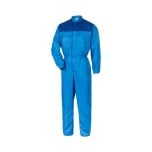
The garment style follows the cleanroom class. A frock covers the upper body and arms and is adequate for the less critical classes ISO 7 to ISO 8. A coverall (full-body suit with hood) encloses the whole body and becomes mandatory from ISO 5 upward.
The lower the ISO class - that is, the cleaner the environment - the more of the wearer's skin and clothing must be covered, because people are the largest particle source in a cleanroom. A frock leaves legs and neck exposed, whereas a coverall combined with a hood, overshoes and gloves forms a closed system.
Why polyester continuous filament instead of cotton?
Cleanroom garments are made of polyester continuous filament, usually with a conductive carbon thread woven in at roughly a 5 mm grid. Continuous filament does not fray and therefore releases almost no particles - unlike cotton or staple fibre, which constantly shed lint.
The densely woven filament acts as a particle barrier: a grid pitch of about 99 µm holds back body-borne particles yet stays breathable. The carbon thread makes the fabric dissipative, so it can double as ESD protective clothing to DIN EN 61340‑5‑1.
- Polyester continuous filament: low particle shedding, dimensionally stable, wash-resistant.
- Carbon grid (about 5 mm pitch): permanently dissipative, ESD-capable.
- Cleanroom-grade seams: outward-facing, folded or welded seams instead of open edges.
- Knitted cuffs at sleeves and legs for a tight closure.
- No cotton, no loose fibres, no open-edge outer pockets.
Sterilisability and wash cycles - what can the fabric take?
Cleanroom garments are not laundered privately but reprocessed in validated cleanroom laundries, dried, particle-tested and individually packed. A high-quality filament fabric typically survives 50 or more wash cycles before its dissipative resistance or barrier performance declines.
For sterile areas - such as pharmaceutical or medical production - the garment must be sterilisable. Common methods are steam sterilisation in an autoclave at 121 °C or gamma irradiation. Only fabrics released for these processes keep their dimensional stability and dissipative properties after sterilisation.
- Track each suit with a wash-cycle counter or chip.
- Re-test the dissipative resistance at defined intervals.
- Discard garments with damage or fibre breakage; never reuse them.
 Cleanroom technology
Plan everything from airlock concept to full personnel outfitting to standard.
Read the guideFrequently asked questions
When is a frock enough and when do I need a coverall?
A frock is adequate for the less critical classes ISO 7 to ISO 8. From ISO 5 upward a full-body coverall with hood, overshoes and gloves is mandatory because the body must be fully covered.
Why is polyester continuous filament used?
Continuous filament does not fray and releases almost no particles, unlike cotton. The dense weave acts as a barrier, while a woven-in carbon thread makes it dissipative and therefore ESD-capable.
How often can cleanroom garments be washed?
High-quality filament suits typically survive 50 or more validated wash cycles. After that the dissipative resistance and barrier performance decline and the garment is retired.
Are cleanroom garments sterilisable?
Released fabrics can be sterilised by autoclave at 121 °C or by gamma irradiation. This is required in pharmaceutical and medical areas; the fabric must be explicitly approved for it.
Looking for the right cleanroom garment?
We supply frocks, coveralls and sterile full-body suits in polyester continuous filament - matched to your cleanroom class per ISO 14644-1.
Class-matched
Garments matched to ISO 14644-1, class ISO 3 to ISO 8.
ESD-capable
Carbon fabric dissipative to DIN EN 61340-5-1.
Wash-resistant
50+ validated wash cycles, fully documentable.
Selection help
We help you choose the right products; technical details are clarified with the manufacturer.