
How to Choose the Right Cleanroom Wipes
Cleanroom wipes have to release as few particles and fibres as possible while still absorbing well. This guide explains how to select them by ISO cleanroom class (ISO 14644-1), the polyester and cellulose materials, plus solvent resistance and edge sealing.
View cleanroom wipesWhich cleanroom class defines the wipe?
The permissible particle and fibre release of a wipe depends on the ISO cleanroom class of the location. ISO 14644‑1 sorts cleanrooms into classes ISO 1 to ISO 9, where a lower number means fewer allowed particles per cubic metre.
For the critical classes ISO 3 to ISO 5, knitted polyester wipes with laser-cut edges are used. In the less critical classes ISO 6 to ISO 8, nonwoven and cellulose blends are also acceptable as long as they are low-lint.
Polyester or cellulose - which material fits?
The material choice decides cleanliness, absorbency and cost. Knitted polyester releases the fewest particles and is chemically resistant, while cellulose or cellulose-polyester blends absorb more liquid and cost less.
- Polyester (100%): lowest particle release, high solvent resistance, ideal for ISO 3‑5 and aggressive cleaners.
- Microfibre polyester: very high cleaning power from fine split fibres, good for final cleaning of optical surfaces.
- Cellulose/polyester blend: high absorbency, picks up spills quickly, for ISO 6‑8 and general wiping.
- Cellulose (100%): most economical and highly absorbent, but higher fibre release - only for non-critical areas.
- Basis weight: light wipes from 150 g/m² for fine cleaning, heavy up to 300 g/m² for spills.
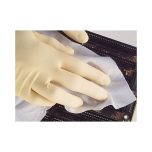
How do I check solvent resistance?
Cleanroom wipes are often saturated with isopropyl alcohol, acetone or other solvents. The material must be resistant so that it does not dissolve and does not release additional extractables (ions, residues).
Polyester is stable against most alcohols and many organic solvents, whereas cellulose can swell or shed fibres with strong solvents. Check the data sheet for extractable ions and for the non-volatile residue (NVR).
Frequently asked questions
What does low-lint mean for cleanroom wipes?
Low-lint means the wipe releases very few fibres and particles. The value is measured per IEST-RP-CC004 and stated on the data sheet as particle and fibre release.
Polyester or cellulose - which is better?
Polyester releases fewer particles and resists solvents better, ideal for ISO 3‑5. Cellulose absorbs more and costs less, but only fits non-critical classes ISO 6‑9.
Why do the wipes need sealed edges?
Raw cut edges shed loose fibres. Laser- or ultrasonically sealed edges melt the fibres at the border and thus prevent a particle source inside the cleanroom.
Which standard defines the cleanroom class?
ISO 14644‑1 classifies cleanrooms by airborne particle concentration (ISO 1 to ISO 9). That class determines which wipe is permitted.
Looking for the right cleanroom wipes?
We supply low-lint polyester and cellulose wipes with sealed edges for every ISO cleanroom class, suited to surface wipe-down and general cleaning.
Class-verified
Wipes matched to ISO 3 through ISO 9 per ISO 14644-1.
Sealed edges
Laser- and ultrasonically sealed for lowest fibre release.
Solvent-resistant
Stable against IPA, acetone and common cleaners.
Selection help
We help you choose the right products; technical details are clarified with the manufacturer.