
Sizing a Compressed Air Ring Main for the Workshop
A well planned compressed air network saves energy and delivers stable pressure at every workstation. This guide shows how to size pipe diameter by flow rate and length, choose the right pipe material, position drops correctly and specify service units.
View workplace equipmentWhy a ring main instead of a dead-end line?
In a ring main the header pipe runs as a closed loop around the workshop, so every drop is fed from two directions. This halves the effective flow path and therefore the pressure drop compared with an open dead-end line. Pressure stays stable even when several workstations draw air at once.
Lay the header with a slight fall of about 1 to 2 percent in the flow direction so condensate runs down to low-point water separators. As a rule of thumb, keep the total pressure drop across the network below 0.1 bar between compressor and the most distant outlet.
- Ring main = closed loop, air supplied from two directions.
- Plan a 1‑2 % fall toward water separators.
- Section isolation valves allow maintenance without shutting the whole net.
- Allow 20‑30 % spare capacity for added demand.
How do you calculate pipe diameter and material?
Pipe diameter follows from flow rate, run length and the allowable pressure drop. Flow velocity in header lines should stay under 6 m/s and in branch lines under 10 m/s, otherwise pressure drop and noise rise. As a rough guide a small workshop often needs DN 25, while larger networks call for DN 40 to DN 50.
For material you can choose galvanised steel, copper, stainless steel or modern aluminium push-fit systems. Aluminium systems are corrosion-free, smooth-bored and quick to install, steel is robust and cheap but rusts without air drying. PVC is not permitted for compressed air because it can shatter under pressure.
How do you set drops and service units?
Drops to the workstations are always taken from the top of the header pipe, never from below. That way no condensate enters the branch line; instead it continues along the header to the separator. A water separator with a drain cock sits at the lowest point of each drop.
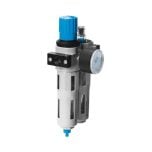
At every workstation a service unit of filter, regulator and optional lubricator delivers conditioned air. The filter removes water and particles (5 µm for general use, 0.01 µm for spray and fine work), the regulator sets the working pressure. Tools with internal lubrication need an oiler, oil-free applications like spraying or blow-off must not have one.
Frequently asked questions
Why take the drop from the top?
Condensate collects at the bottom of the header pipe. Taking the drop from the top keeps water out of the branch line and the tool, and lets it drain instead to the water separator.
What pipe diameter do I need?
It depends on flow rate, run length and pressure drop. A small workshop often needs DN 25, while larger networks with several workstations need DN 40 to DN 50. Keep flow velocity below 6 m/s.
Is a ring main really necessary?
For more than two or three workstations it clearly pays off. Two-sided feed lowers pressure drop and keeps pressure stable under simultaneous use. Small networks manage with a single dead-end line.
Does every workstation need a lubricator?
No. Tools with internal lubrication benefit from an oiler, while oil-free applications such as spraying, blow-off or breathing air must stay free of oil mist. There you use filter and regulator without a lubricator.
Planning a workshop air network?
We supply pipe systems, drops and service units of filter, regulator and lubricator - matched to flow rate and workstation.
Stable pressure
Ring main and correct nominal size keep pressure constant.
Dry air
Top-fed drops and separators protect your tools.
Right service unit
Filter, regulator and lubricator matched to the tool.
Selection help
We help you choose the right products; technical details are clarified with the manufacturer.