
Conductive Adhesive for ESD - How to Choose Correctly?
Conductive adhesives bond components mechanically while carrying current or draining static charge. This guide explains the difference between electrically conductive and merely dissipative, which resistance values apply, how silver filling and cure conditions differ, and what matters during processing.
To the guidesContents
Conductive or Dissipative - What Is the Difference?
ESD adhesives split into two classes. Electrically conductive adhesives replace soldering and form a true electrical connection, for example between chip and substrate. Dissipative adhesives bond parts mechanically and only drain static charge in a controlled way.
The decisive figure is resistance. Conductive adhesives show a volume resistivity below 10⁻³ Ω·cm, while dissipative systems sit in a surface resistance range of roughly 10⁵ to 10⁹ Ω, meeting the DIN EN 61340‑5‑1 requirements for dissipative materials.
What Role Does Silver Filling Play?
Conductivity comes from metallic fillers in the resin. The most common is silver as flake or particle, because it still conducts well even as an oxide. Only above a certain filler concentration do the particles touch continuously and form a conductive path (percolation threshold).
Silver-filled one-component epoxies typically contain 60 to 80 percent silver by weight. More filler lowers resistance but makes the paste stiffer and more expensive. Pure dissipation only needs carbon-filled or silver-glass systems with far less precious metal.
What Matters During Curing?
Cure conditions decide final resistance, adhesion and component protection. Silver epoxies cure either fast at 120 to 150 °C in minutes or slowly at 60 to 80 °C, or even at room temperature over several hours.
- Heat cure (120‑150 °C): lowest resistance, best strength - only for heat-stable parts.
- Low temperature (60‑80 °C): protects heat-sensitive components, longer times.
- Room temperature/two-component: for repairs without an oven, keep the mix ratio exact.
- UV or moisture-curing systems for special joining tasks.
- Mind pot life and storage (often frozen at -40 °C) - let thawed paste acclimatise before use.
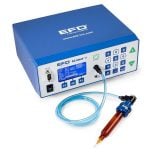 Soldering stations
Where bonding is not enough: controlled soldering stations for secure joints.
View productsFrequently asked questions
Can conductive adhesive replace soldering?
For many repairs and temperature-sensitive parts, yes. Silver-filled epoxies form an electrical connection without heat shock, but do not reach the mechanical load capacity of a soldered joint at high currents.
What does volume resistivity mean?
It describes how well the cured material conducts current through its bulk, given in Ω·cm. Electrically conductive adhesives are below 10⁻³ Ω·cm, dissipative systems much higher in the dissipative range.
Why silver and not copper?
Silver oxide still conducts well, whereas copper oxide insulates. That is why silver stays conductive despite ageing and remains the standard filler for reliable contacts.
Does silver-filled adhesive need cold storage?
One-component epoxies are usually stored at -40 °C to extend pot life. Bring the closed container to room temperature before opening so no condensation gets in.
Looking for the right conductive adhesive?
Silver-filled and dissipative adhesives for ESD applications can be matched to resistance value, filler and cure conditions - more in our guides.
Standard compliant
Dissipative systems meet DIN EN 61340-5-1.
Defined resistance
Values in Ω·cm and Ω stated in the data sheet.
Verified joint
Resistance measurable and documented after curing.
Selection help
We help you choose the right products; technical details are clarified with the manufacturer.