
Indoor Air Quality: Measuring VOC and Particulate Matter
Poor indoor air lowers focus and comfort at the workplace. This guide explains how to measure VOC and particulate values, rank them against the reference limits of VDI 4300 and DIN EN 16798, and improve air quality with targeted measures.
View metersContents
Which values describe indoor air quality?
Indoor air quality is described by several values: VOC (volatile organic compounds, as the sum value TVOC), particulate matter (PM2.5 and PM10), CO₂ as a ventilation indicator, plus temperature and relative humidity. Only the combination gives a reliable picture.
TVOC covers solvents, off-gassing from furniture, cleaners and building materials. Particulate matter comes from laser printers, solder fume, outdoor traffic and abrasion. CO₂ shows how well a room is ventilated, since it rises with the number of people.
How do you measure VOC and particulates correctly?
The VDI 4300 guideline series defines the measurement strategy for indoor air: measuring height, duration, room use and distance from windows and sources must be set. In everyday workplace use, permanently installed sensors that record continuously have proven best.
- TVOC sensors (MOX technology) give a fast trend, not a substance-specific analysis.
- Particulate sensors using the light-scattering principle capture PM2.5 and PM10 in µg/m³.
- CO₂ sensors with NDIR technology are low-drift and ideal for ventilation control.
- Measuring height around 1.1 to 1.5 m in the breathing zone, not right at the window.
- Reference measurement per VDI 4300 for legally sound assessments.
How do you rank readings under DIN EN 16798?
DIN EN 16798‑1 defines four indoor air quality classes (IDA 1 to IDA 4) based on the CO₂ rise above outdoor air. IDA 1 (high quality) sits at around 550 ppm above outdoor air, IDA 2 at about 800 ppm. From these the required outdoor air flow rates per person are derived.
For assessment: a single peak reading says less than the daily trend. So document averages, maxima and the duration of exceedances. This reveals whether a source is permanently active or only a brief nuisance.
Which measures improve the air?
The most effective measure is source reduction, followed by targeted ventilation and filtration. Only once these are exhausted do mobile air purifiers complete the concept.
- Remove the source: low-emission furniture and cleaners, laser printers out of the breathing zone.
- Burst ventilation guided by a CO₂ traffic light, or mechanical ventilation to the IDA class.
- Particulate filters of class ISO ePM1 (formerly F7 to F9) in the supply air.
- Activated carbon filters bind VOC and odours in recirculated air.
- HEPA air purifiers (H13/H14) for particulates in polluted rooms.
- Extract solder fume right at the source instead of spreading it across the room.
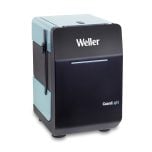 Solder fume extraction
How to protect staff from solder fume and particulates at the bench.
View productsFrequently asked questions
What does TVOC mean and when does it get critical?
TVOC is the sum value of volatile organic compounds. Under the UBA stages, below 300 µg/m³ is harmless, from 1000 µg/m³ you should ventilate and above 3000 µg/m³ the value is hygienically unacceptable.
Which particulate level is acceptable at the workplace?
The WHO recommends a daily mean of at most 25 µg/m³ for PM2.5 and at most 45 µg/m³ for PM10. Indoor spaces should stay well below these, since extra sources such as printers act here.
Is CO₂ a pollutant or just an indicator?
At normal concentrations CO₂ is not a pollutant but an indicator of ventilation quality. Once it rises above 1000 ppm, fresh air supply is too low and other loads accumulate along with it.
Is a cheap VOC sensor enough for assessment?
For ongoing monitoring and trends a MOX sensor is enough. For a legally sound assessment per VDI 4300 a substance-specific lab analysis is needed, since the sensor only delivers a sum value.
Keeping an eye on indoor air quality?
We supply meters for VOC, particulates and CO₂ as well as air purifiers and filters - matched to the reference limits of VDI 4300 and DIN EN 16798.
Standards-based
Assessment per VDI 4300 and DIN EN 16798.
Precise sensors
NDIR, MOX and light-scattering technology available.
Documentable
Continuous logging for verifiable proof.
Selection help
We help you choose the right products; technical details are clarified with the manufacturer.