
Testing ionisers: the Desco 19433 Verification Kit
Ionisers neutralise charges in the EPA, but their performance fades over time, often without any visible sign. Only a measurement shows whether balance and discharge time are still right. We explain what ANSI/ESD SP3.3 and ESD TR53 provide and how the Desco Ioniser Verification Kit 19433 makes testing possible right at the workstation.
View the verification kitContents
Why ionisers need regular testing
An ioniser works quietly in the background. That is why nobody notices when it drifts out of balance or removes charge too slowly. Only a measurement shows either.
Two values are measured for verification: the offset voltage (balance), which shows whether the ioniser delivers positive and negative ions in equilibrium, and the discharge time, meaning how quickly it removes an applied charge.
An ioniser that has drifted out of balance can itself place a charge on sensitive components or assemblies. Desco therefore points out that ionisers should be checked regularly for offset voltage and discharge time.
What ANSI/ESD SP3.3 and ESD TR53 provide
ANSI/ESD SP3.3 describes the periodic verification of ionisers, ESD TR53 the compliance verification of ESD protective equipment. Both use the same two measurements: offset voltage and discharge time.
| Document | Purpose |
|---|---|
| ANSI/ESD STM3.1 | Test method using a Charged Plate Monitor, suited to evaluating, selecting and qualifying ionisers |
| ANSI/ESD SP3.3 | Simplified periodic verification with a portable instrument, can be carried out under actual use conditions |
| ESD TR53 | Compliance verification of ESD protective equipment, for ionisers discharge time and offset voltage are checked against the user's specification |
According to SP3.3, each ioniser is tested in its normal operating configuration. In general this applies to all ionisers, not just a sample. The measurements should already be taken at acceptance so that a baseline exists for later comparison. The aim is to detect a significant change in performance.
The Desco Ioniser Verification Kit 19433
The Desco Ioniser Verification Kit 19433 contains everything needed to measure the offset voltage and discharge time of an ioniser right at the workstation, without removing the unit.
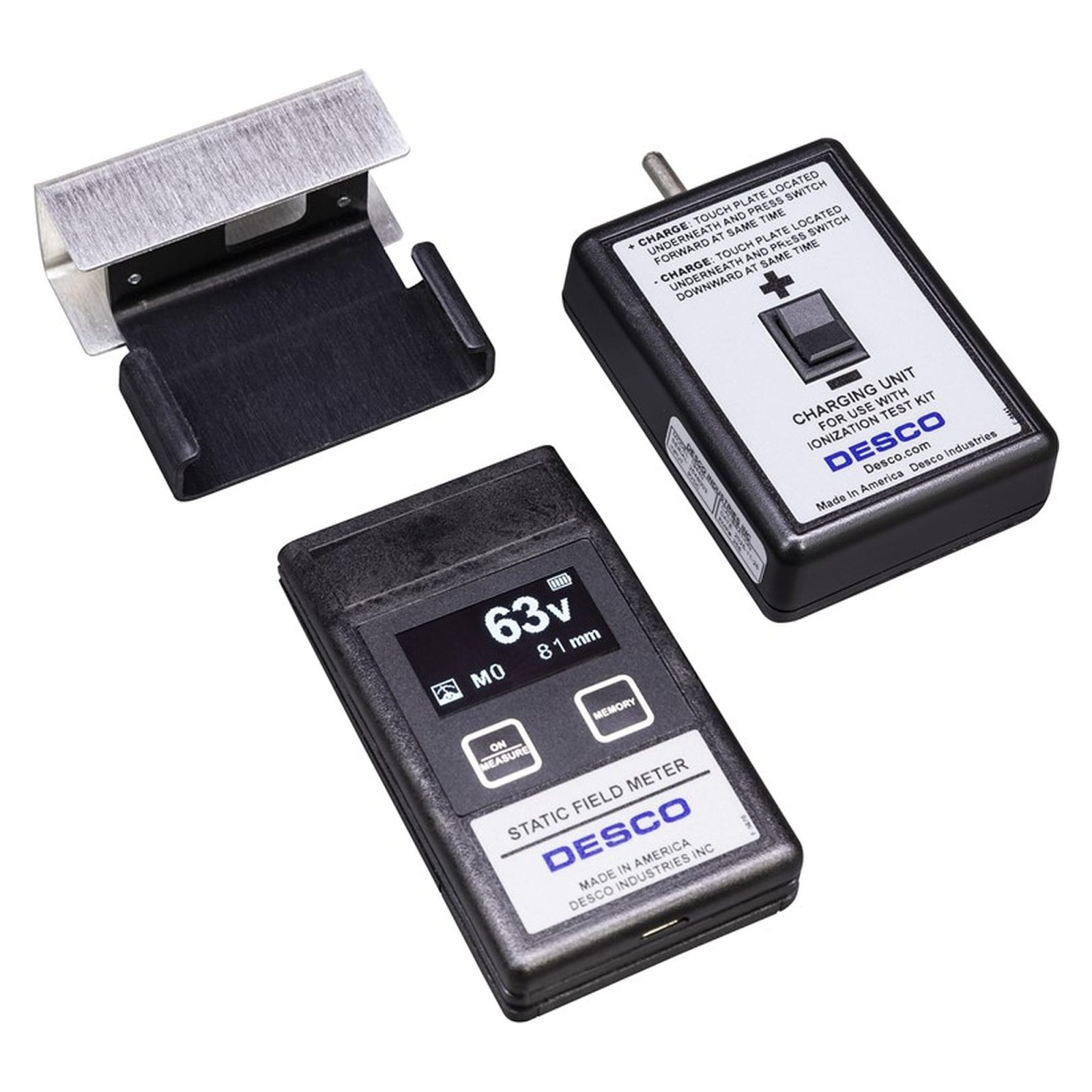
- Static field meter 19432 with a measuring range up to ±40.0 kV
- Conductive plate made of aluminium for offset voltage and discharge time
- ±1000 V charger, brings the plate to test voltage
- USB-C charging cable (1 m) for the field meter battery
- Carrying case made of polypropylene with foam insert
The kit is NIST traceably calibrated, made in the USA and suited to checking benchtop, overhead and compressed air ionisers in ESD protected areas.
Complete set for offset voltage and discharge time per ANSI/ESD SP3.3 and ESD TR53.
View productAvailable separately, with ToF distance sensor, OLED display and USB-C battery.
View productFitted nylon protection for the field meter 19432 on inspection rounds.
View productHow testing with the kit works
The procedure follows the Desco operating instructions TB-3106: attach the plate, measure the balance, then time the discharge for both polarities.
The plate is slid onto the field meter and the device switches to conductive plate mode (CPM). The operator must be grounded, because the field meter is grounded through the operator's hand, and the charger also only works with a grounded operator.
- Offset voltage: hold the field meter with the plate so that the ionised airflow reaches the plate. The display shows the offset voltage (balance).
- Positive discharge time: charge the plate with the charger to more than +1000 V and use a stopwatch to time how long the voltage takes to fall from +1000 V to +100 V.
- Negative discharge time: the same with a negative charge, from -1000 V to -100 V.
- Document: record the results and compare them with the specification and the baseline.
Between tests, keep the insulators of the plate clean so that surface leakage does not distort the result. According to Desco, the 9 V battery in the charger should be replaced once a year.
Field meter 19432, holster 19434 and video tutorials
Beyond ioniser testing, the field meter in the kit also measures charges on insulators and is available separately. A matching belt holster is available for inspection rounds.
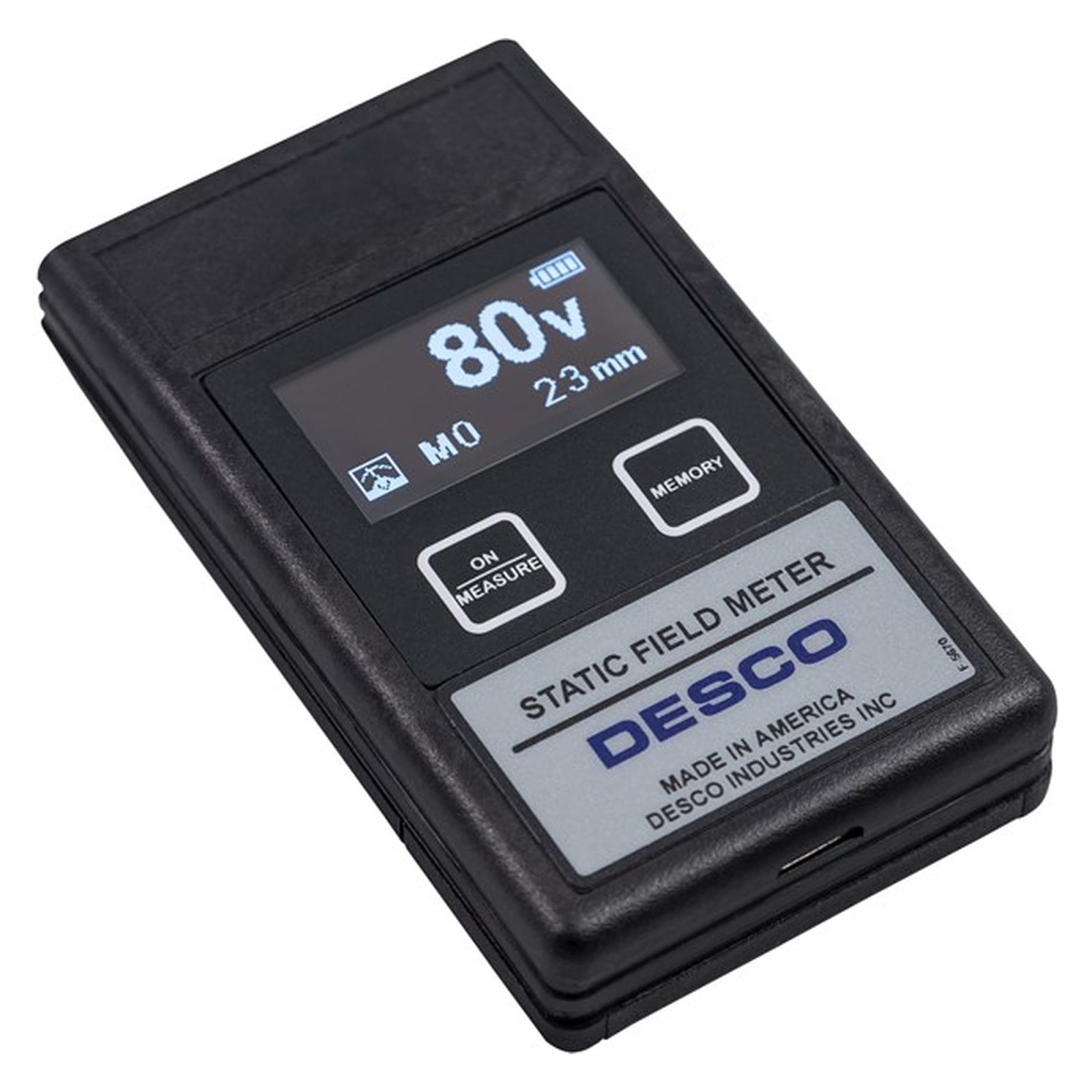
The Desco static field meter 19432 measures 0 to ±40.0 kV with polarity display. A time-of-flight sensor detects the distance from 1 to 200 mm and corrects the reading automatically. Snapshot hold freezes the value as soon as you pull the device away from the object, 10 readings can be stored and read out via USB-C.
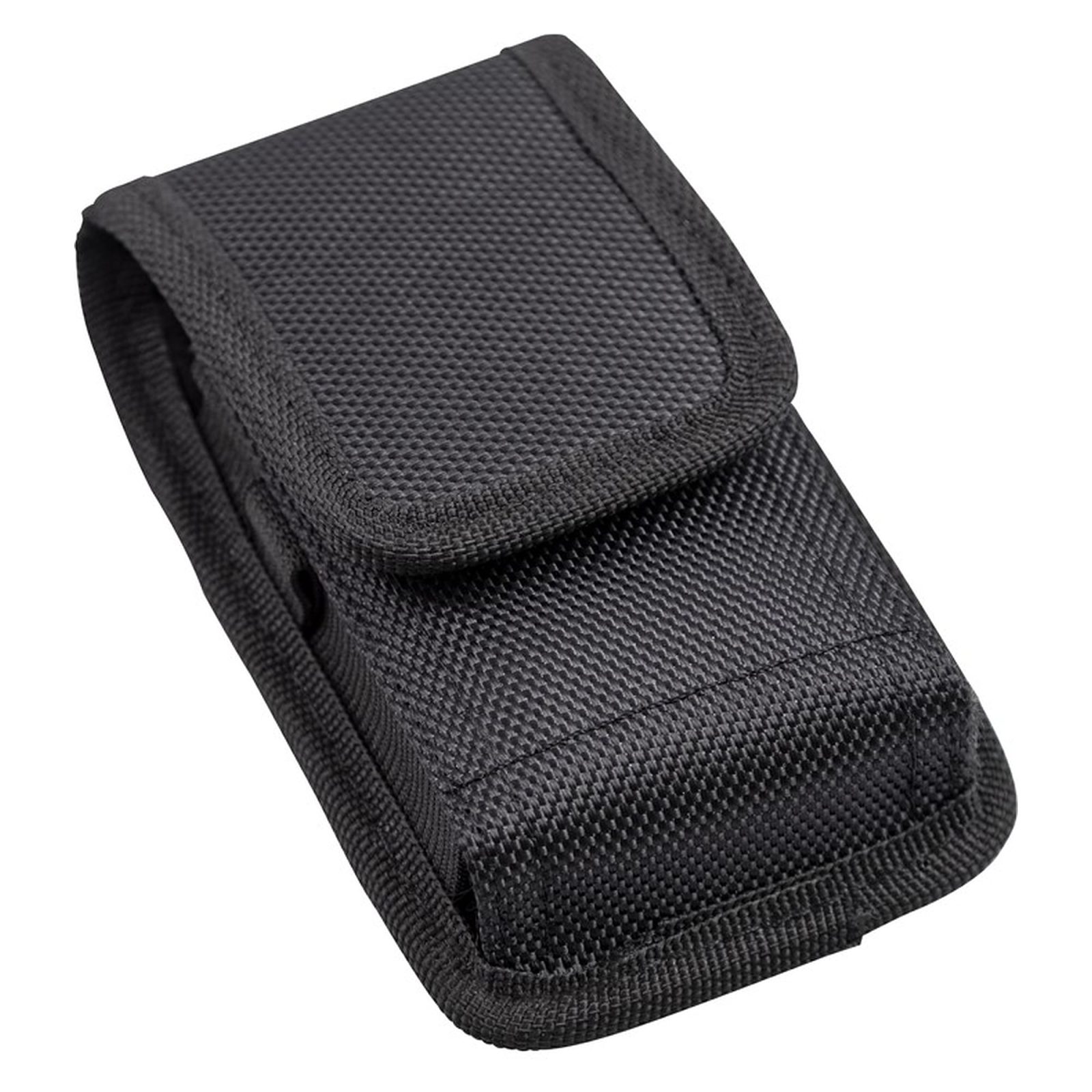
The nylon belt clip holster 19434 protects the field meter from bumps and scratches and keeps it within reach on your belt, leaving both hands free between measurements.
Frequently asked questions
How often should I test ionisers?
The user defines this in the verification plan, depending on ioniser type, environment and requirements. What matters is a baseline taken at acceptance, against which later measurements are compared.
Can I test the ioniser at the workstation?
Yes. ANSI/ESD SP3.3 provides for testing under actual use conditions in the normal operating configuration. With the kit 19433 no removal is needed.
Do I need the field meter 19432 in addition to the kit?
No, the field meter is included in the kit 19433. The field meter 19432 is also available separately.
Does the kit replace qualification per ANSI/ESD STM3.1?
No. The kit is for periodic verification. For evaluation and qualification of an ioniser per STM3.1, Desco recommends a Charged Plate Monitor.
Which ionisers can be tested with the kit?
According to Desco, the kit is suited to regular checks of benchtop, overhead and compressed air ionisers in ESD protected areas.
Request the Verification Kit 19433
Want to test your ionisers regularly? Tell us which ionisers you use and we will send you a quote for the Desco kit and matching accessories.
Desco in our range
Quote and delivery from one source.
Calibrated test equipment
Desco kit with NIST traceable calibration.
Standards in view
Testing per ANSI/ESD SP3.3 and ESD TR53.
Matching accessories
Belt clip holster 19434 for the field meter 19432.