
IPC-A-610 Acceptance Criteria - what makes a good joint?
IPC-A-610 is the global standard for the visual assessment of electronic assemblies. This guide explains the three product classes, the key acceptance criteria for solder and SMT joints, and the difference between target, acceptable and defect.
View solderingWhat do the three IPC-A-610 classes mean?
IPC-A-610 sorts electronic assemblies into three classes based on their requirement profile. The class determines how strictly a solder joint is judged - the higher the risk of failure, the stricter the criteria.
Class 1 covers general electronic products where the main requirement is basic function. Class 2 covers dedicated service products where continued performance is desired but occasional failure is tolerable. Class 3 applies to high-reliability assemblies whose failure could be life-threatening, such as medical, aerospace and safety systems.
Which visual criteria apply to a solder joint?
IPC-A-610 uses three assessment levels: target, acceptable and defect. A good solder joint shows a smooth, concave fillet and a good wetting angle of roughly 90 degrees or less.
- Wetting: the solder flows evenly and forms a low wetting angle, ideally well below 90 degrees.
- Through-hole fill (THT): Class 1 needs no full fill, Class 2 at least 75 percent, Class 3 at least 75 percent with a visible fillet on both sides.
- Solder volume: neither too little (missing fillet) nor too much (a blob that hides the contour).
- Surface: with lead-free solders a slightly dull, grainy surface is normal and not a defect.
- No cracks, no cold joints, no solder bridges to neighbouring terminals.
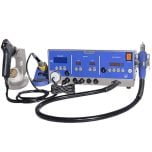 Choose a soldering station
Temperature-stable stations are the basis for repeatably good joints.
View productsHow do you apply IPC-A-610 at the bench?
Visual inspection is done under defined conditions: adequate lighting of at least 1000 lux and a magnification matched to the component pitch. For fine pitch a stereo microscope or a magnifier lamp with 3x to 10x is common.
- Train inspectors to IPC-A-610 (CIS) and keep certification current.
- Ensure ESD protection at the inspection station so the assembly is not damaged.
- Keep limit samples and photo examples at the bench to judge borderline cases consistently.
Frequently asked questions
Which class applies if nothing was agreed?
If no class is specified, Class 2 usually applies. For safety-critical or high-reliability products the class should always be fixed explicitly in writing.
Is a dull solder joint a defect?
No. With lead-free solders a slightly dull, grainy surface is normal and not a defect under IPC-A-610. A defect only exists with poor wetting, cracks or wrong solder volume.
How much through-hole fill is needed?
Class 2 and 3 require at least 75 percent fill of the plated through-hole. Class 1 needs no full fill as long as the connection works.
Does IPC-A-610 replace electrical testing?
No. IPC-A-610 is a purely visual acceptance standard. Electrical function and in-circuit tests are still required in addition.
Setting up a bench to IPC-A-610?
We supply soldering stations, magnifier lamps and ESD equipment for repeatably good joints - suited to Class 1, 2 and 3.
Standard-aligned
Equipment matched to visual acceptance under IPC-A-610.
Process-safe
Temperature-stable stations for consistent solder quality.
Verifiably judged
Magnifiers and microscopes for class assessment.
Selection help
We help you choose the right products; technical details are clarified with the manufacturer.