
M8 or M12 connectors - which fits your application?
M8 and M12 are the standardised circular connectors of industrial sensor and actuator wiring. This guide compares size, pin count and current rating and explains when you need A, B or D coding.
View connectorsWhat is the basic difference between M8 and M12?
M8 and M12 refer to the metric diameter of the coupling thread: 8 mm for M8, 12 mm for M12. Both are described in the IEC 61076‑2 standard series and are typically sealed to IP67 when screwed tight. The larger M12 offers room for more contacts and higher currents.
M8 is preferred on compact sensors with 3 or 4 pins where space is tight. M12 is the standard for more demanding connections with 4, 5, 8 or 12 pins, such as actuators, valve manifolds and Industrial Ethernet.
What do A, B and D coding stand for?
Coding is a mechanical shaping of the contact insert that prevents signal and power lines from being accidentally swapped. Each coding is assigned to a use case and only mates with the matching counterpart.
- A coding: the classic choice for sensors, actuators, analogue signals and DC voltage.
- B coding: for fieldbuses such as PROFIBUS and other serial bus systems.
- D coding: for Industrial Ethernet up to 100 Mbit/s (Fast Ethernet, 4-pin).
- X coding: for high-speed Ethernet up to 10 Gbit/s (8-pin) where D is not enough.
- L, S and T coding: for power and drives with higher currents and voltages.
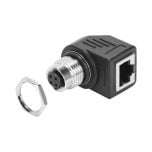
How do you choose pin count and version correctly?
First count the signals you need: a simple proximity switch manages with 3 pins, an IO-Link device needs 4 pins, an analogue sensor with separate supply often needs 5 pins. Size and coding follow from there.
- Environment: choose IP69K for high-pressure cleaning, otherwise IP67 is sufficient.
- Assembly: overmoulded cables seal better than self-assembled field connectors.
- Temperature and oil: PUR jacket for moving drag chains, PVC for simple applications.
- Mating cycles: screwed M8/M12 are rated for many hundreds of connect operations.
Frequently asked questions
Can M8 and M12 mate with each other?
No. The thread diameters differ, so an M8 plug will not fit an M12 socket. However, adapter cables are available to bridge the two sizes.
When do I need D coding instead of A?
D coding is intended for Industrial Ethernet up to 100 Mbit/s. For plain sensor and actuator signals or IO-Link the A coding is sufficient.
How many pins does an IO-Link sensor need?
IO-Link devices of port class A typically use 4 pins in M12 or M8 with A coding and an unshielded standard cable.
How high is the protection rating really?
IP67 only applies when the connector is correctly screwed tight. Loosely plugged or unsecured connectors do not reach the stated sealing.
Looking for M8 or M12 connectors?
We supply pre-assembled and field-wireable circular connectors in all common codings and pin counts - matched to your sensors and actuators.
Standard compliant
Connectors per IEC 61076-2 with defined protection rating.
Every coding
A, B, D and X available from stock.
Ethernet ready
D and X coded cables for Industrial Ethernet.
Selection help
We help you choose the right products; technical details are clarified with the manufacturer.