
How to choose a power quality analyzer to EN 50160?
A power quality analyzer checks whether the supply voltage stays within the limits of EN 50160. This guide explains measurement Class A per IEC 61000-4-30, the key parameters harmonics, flicker and voltage dips, and how to select and connect the right instrument.
To the guidesWhat does EN 50160 assess and why Class A?
EN 50160 describes the characteristics of the voltage in the public supply network: frequency, magnitude, waveform and symmetry. It sets limits, for example that 95 % of the 10-minute mean values of the voltage must stay within ±10 % of nominal. The power quality analyzer records these values over a typical observation window of one week.
How the measurement is taken is governed instead by IEC 61000‑4‑30. It defines two accuracy classes: Class A for reliable, legally defensible measurements and Class S for indicative checks. Only a Class A instrument delivers results that are reproducible between different manufacturers and usable for complaints to the network operator.
- Frequency: 50 Hz, in the interconnected grid within ±1 % for 99.5 % of the year.
- Voltage magnitude: 95 % of the 10-min means within ±10 % Un.
- Observation window: usually 7 continuous days.
- Class A uses fixed aggregated intervals of 10 min, 2 h and 10 s.
Capturing harmonics, flicker and voltage dips
The three most common disturbances are harmonics, flicker and voltage dips. Each has its own limits and its own evaluation method that the analyzer must implement correctly.
Harmonics are multiples of the fundamental frequency produced by switch-mode power supplies, variable-speed drives and LED drivers. The THD sums them up, but the standard also limits individual orders, for example the 5th harmonic to 6 %. A good analyzer shows the spectrum at least up to the 50th order and cleanly separates harmonics from interharmonics.
- Voltage dip: residual voltage 1 % to 90 % Un, duration 10 ms to 1 min.
- Interruption: voltage below 1 % Un, usually from protective tripping.
- Swell: voltage above 110 % Un, often after load rejection.
- Dips are classified by depth and duration, not against a single fixed limit.
What matters when selecting the instrument?
Besides the measurement class, the number of channels, current sensors, memory and safety category decide practical suitability. For a three-phase network you need four voltage and four current paths so that the neutral conductor is captured too.
The safety category must suit the measurement location. At the service entrance and in main distribution CAT IV applies, in sub-distribution boards CAT III. Also check the matching current clamps: flexible Rogowski coils for high currents and hard-to-reach busbars, classic clamps for accurate readings in the lower range.
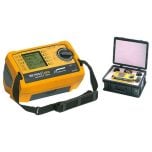 Measuring instruments overview
From power meters to Class A analyzers - the right technology for every task.
View productsFrequently asked questions
Is a multimeter enough for power quality measurement?
No. A multimeter shows only RMS values, but neither the harmonic spectrum nor flicker or time-resolved voltage dips. An assessment to EN 50160 requires a power quality analyzer per IEC 61000‑4‑30.
What is the difference between Class A and Class S?
Class A uses firmly defined measurement methods and aggregation intervals, so results are reproducible and legally sound. Class S is more tolerant and serves indicative checks, for example during fault finding.
How long do I need to measure?
EN 50160 evaluates a continuous period of one week using 10-minute mean values. Fault finding often needs shorter recordings, but a standard-compliant report requires the full 7 days.
Why are harmonics a problem?
They add extra heating to neutral conductors and transformers, can trip fuses unexpectedly and disturb electronics. EN 50160 therefore limits the THD to 8 % and individual orders separately.
Looking for the right power quality analyzer?
Class A analyzers per IEC 61000-4-30 with current clamps and evaluation software enable standard-compliant EN 50160 reports. More in our guides.
Standard compliant
Instruments to IEC 61000-4-30 Class A for EN 50160.
Measured safely
CAT IV accessories for service entrance and distribution.
Complete parameters
Harmonics, flicker and dips in a single instrument.
Selection help
We help you choose the right products; technical details are clarified with the manufacturer.