
Compressed air quality to ISO 8573-1 - which class do you need?
ISO 8573-1 rates compressed air with three purity classes for particles, water and oil. This guide explains the class numbers, their limit values and how to derive the right treatment chain of filters, dryers and activated carbon for your industry.
View air treatmentWhat do the ISO 8573-1 purity classes mean?
ISO 8573‑1 rates compressed air with three figures written as particles : water : oil, for example class 1:4:1. Each figure represents its own class, and the lower the number, the cleaner the air. This lets you define the required quality unambiguously in a short code.
For particles the classes define the maximum number of solid particles per cubic metre, graded by size. For water the pressure dew point is decisive, and for oil it is the total residual oil content from aerosol, liquid oil and oil vapour combined.
What does the right treatment chain look like?
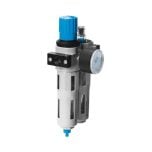
Treatment follows a fixed order: coarse separation first, then drying, and fine filtration last. Each stage removes a different type of contaminant, and the sequence protects the more sensitive downstream elements from overload.
- Cyclone separator and pre-filter: remove condensate and coarse particles from about 5 µm.
- Fine filter (coalescing filter): captures oil aerosols and particles down to 0.01 µm.
- Refrigeration dryer: reaches a pressure dew point of +3 °C for general use (water class 4).
- Adsorption dryer: delivers -40 °C to -70 °C for frost-proof or very dry air.
- Activated carbon filter: binds oil vapour and odours for oil class 1.
- Sterile filter: as the final stage for food and medical applications.
Which class does your industry need?
The target class depends on the application risk. Control air for cylinders tolerates more residual oil than a paint line, and food production sets the strictest limits on oil and germs.
For oil-free applications an oil-free compressor is the safest route, because even the smallest residual oil traces are critical in the system. Where an oil-lubricated compressor stays in place, the combination of coalescing and activated carbon filter delivers oil class 1.
Frequently asked questions
What do the three ISO 8573-1 numbers stand for?
The first number describes the particle class, the second the water content via the pressure dew point and the third the total residual oil content. Lower numbers mean cleaner air.
Which pressure dew point belongs to water class 4?
Water class 4 corresponds to a pressure dew point of +3 °C, as reached by a refrigeration dryer. For frost protection or dry air, class 2 (-40 °C) or 1 (-70 °C) via an adsorption dryer is required.
How do I achieve oil-free air to class 1?
With a coalescing filter followed by an activated carbon filter that binds oil vapour and keeps residual oil below 0.01 mg/m³. The safest addition is an oil-free compressor.
Do I have to state all three classes?
Yes. A complete requirement always names the particle, water and oil class, for example 1:4:1. Without all three values the air quality is not clearly defined.
Looking for the right air treatment?
We supply filters, refrigeration and adsorption dryers and activated carbon stages for every purity class to ISO 8573-1 - matched to your application.
Standard-based
Treatment designed to ISO 8573-1:2010.
Measurably clean
Residual oil and dew point testable and documented.
Complete chain
Filter, dryer and activated carbon from one source.
Selection help
We help you choose the right products; technical details are clarified with the manufacturer.