
Choosing a respirator mask: which FFP class is right?
The right respirator mask depends on the type and concentration of particles in the air. This guide explains the FFP classes to EN 149, the difference between filtering masks and half masks with replaceable filters, and how to select for dust, solder fume and aerosols including wear time.
To the guidesWhat do FFP1, FFP2 and FFP3 mean?
FFP stands for Filtering Face Piece, the particle-filtering half mask defined in EN 149. The three classes differ in filter efficiency and maximum permitted leakage: FFP1 filters at least 80 %, FFP2 at least 94 % and FFP3 at least 99 % of the test particles.
What matters is the factor relative to the occupational exposure limit (OEL). FFP1 may be used up to 4 times the limit, FFP2 up to 10 times and FFP3 up to 30 times. The finer and more toxic the particles, the higher the class must be.
FFP mask or half mask with replaceable filter?
The filtering FFP half mask is the complete filter medium and is discarded as a whole or reused for a limited time. The half mask with replaceable filters to EN 140 has a silicone or TPE body and screw-on filters to EN 143 (particles) or EN 14387 (gases).
For pure particle exposure an FFP mask is usually enough. As soon as vapours, solvents or high comfort over long periods are required, the half mask with exchangeable filters pays off, because only the filter is replaced.
- P1/P2/P3 filters (EN 143): against solid and liquid particles, colour code white.
- A filters (brown): organic gases and vapours such as solvents and adhesives.
- Combined A2-P3 filter: vapour and particles at once, ideal for gluing plus sanding.
- Silicone mask body: seals well and can be cleaned and reused many times.
Which mask for dust, solder fume and aerosols?
The choice depends on the specific source. Solder fume contains rosin aerosols and fine dust, so at least FFP2, ideally FFP3, applies here. Aerosols and spray mist also require FFP2 or FFP3, while coarse wood or construction dust is often covered by FFP1 to FFP2.
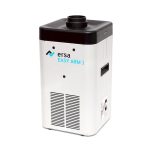 Solder fume extraction
How to keep fume and aerosols out of the breathing zone right at the bench.
View products
How long may a respirator mask be worn?
Wear time is limited by breathing resistance. Under the rules for the use of respiratory protective devices, filtering half masks without an exhalation valve have a maximum wear time of 75 minutes followed by a 30 minute recovery break; a valve extends the permitted wear time.
- FFP without valve: about 75 min wear, then 30 min break.
- FFP with valve: up to about 120 min, then recovery.
- A damp or clogged mask felt as higher breathing resistance: change immediately.
- Beards and spectacle arms break the face seal and reduce protection.
Frequently asked questions
Is FFP2 enough for solder fume?
FFP2 is the minimum recommendation for occasional soldering. For continuous work or heavy fume, FFP3 makes sense, combined with solder fume extraction directly at the source.
What is the difference between FFP3 and a half mask with a P3 filter?
Both achieve at least 99 % filter efficiency. The half mask with a replaceable P3 filter is reusable, often seals better and can be extended with gas filters.
How long does an FFP mask last?
An NR mask is intended for one shift, an R mask for several. Regardless of this it must be changed immediately when breathing resistance rises noticeably, it becomes damp or it is damaged.
Does a mask protect over a beard?
No. A beard in the sealing area prevents a tight fit, so unfiltered air enters. Only powered systems with a hood help here.
Looking for the right respiratory protection?
FFP masks and half masks with replaceable filters for dust, solder fume and aerosols, tested to EN 149 and EN 140 - more in the guide.
Standard tested
Masks to EN 149 and filters to EN 143 and EN 14387.
Right class
Selection by particle type and limit-value factor.
Tight fit
Models with a good face seal and exhalation valve.
Selection help
We help you choose the right products; technical details are clarified with the manufacturer.