
Safety Shoes S1 to S3 - which class do you need?
Safety shoes protect feet from impact, penetration and slipping. This guide explains the protection classes S1 to S3 under EN ISO 20345, the 200 J toe cap, penetration resistance and slip resistance to help you choose.
View safety shoesWhat does EN ISO 20345 define?
Safety shoes are governed by the standard EN ISO 20345. Their defining feature is the protective toe cap, which withstands an impact of 200 joules and a compression load of 15 kN. This 200-joule cap is what separates safety shoes from ordinary occupational shoes (EN ISO 20347).
The cap can be made of steel, aluminium or plastic (composite). Composite caps are lighter, metal-free and do not conduct cold, while steel caps are very robust and slim. In certified footwear all variants meet the same 200-joule requirement.

How do S1, S2 and S3 differ?
The protection classes bundle common extra properties into packages. S1 suits dry indoor areas, S2 adds a water-resistant upper, and S3 adds penetration resistance plus a cleated outsole.
- S1: light and breathable for dry indoor rooms.
- S2: same protection plus a water-repellent upper.
- S3: the all-rounder for construction and outdoor use with penetration resistance and a deep-cleat sole.
- S3 is the best-selling class because it covers almost all construction-site risks.
How do penetration and slip resistance work?
Penetration resistance stops a nail or splinter from piercing the sole. A steel insert (letter P) withstands a test force of 1100 N, while textile inserts (PL/PS) are lighter, more flexible and metal-free, but cover a smaller area depending on the nail geometry.
Slip resistance is tested on ceramic with a detergent and on steel with glycerine. Since 2022 basic slip resistance (formerly SRA/SRB) is a fixed part of every safety-shoe certification; the extra code SR marks an extended test on both surfaces.
- Steel insert (P): maximum protection against thin nails, only marginally heavier.
- Textile insert (PL/PS): lighter and more flexible, metal-free for airports and cold.
- Cleated sole: deep lugs channel water and dirt away and secure grip.
- HRO: outsole briefly heat-resistant up to 300 °C for hot floors.
How do I choose fit and antistatic correctly?
A safety shoe only protects if it fits. Measure your feet in the afternoon when they are slightly swollen and leave about 10 to 15 mm of space in front of the toes. The toe cap must not press on your toes.
Almost all classes from S1 upwards are antistatic (A) with a through-resistance of roughly 10⁵ to 10⁹ Ω. For electronics manufacturing and ESD protected areas this is not enough: there dedicated ESD shoes per EN 61340‑5‑1 with a resistance below 35 MΩ are required.
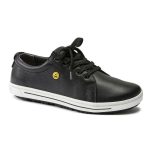 ESD protection in the EPA
When ordinary antistatic is enough and when true ESD shoes are needed.
View productsFrequently asked questions
How much impact must the toe cap withstand?
Under EN ISO 20345 the protective toe cap withstands an impact of 200 joules and a static compression force of 15 kN. That equals roughly 20 kg dropped from about one metre.
What is the difference between S1 and S3?
S1 is intended for dry indoor areas and is antistatic. S3 adds a water-resistant upper, penetration resistance of the sole and a coarse cleated outsole, making it suitable for construction and outdoor work.
Steel cap or composite cap?
Both meet the 200-joule requirement. Plastic or composite caps are lighter, metal-free and thermally neutral, while steel caps are slimmer and very robust.
Are antistatic shoes automatically ESD shoes?
No. Antistatic shoes (A) roughly limit charging, while ESD shoes per EN 61340‑5‑1 meet stricter limits below 35 MΩ and are mandatory in electronics manufacturing.
Looking for the right safety shoes?
We supply safety shoes in classes S1 to S3 with tested toe protection, penetration resistance and slip resistance per EN ISO 20345.
Standard-tested
All models meet EN ISO 20345.
Penetration-proof
S3 with a sole insert against nails and splinters.
Slip-resistant
Tested grip on wet and oily floors.
Selection help
We help you choose the right products; technical details are clarified with the manufacturer.