
Sizing valves: choosing Kv value and nominal size right
The Kv value describes the flow through a valve at a defined pressure drop and is the key figure for valve sizing. This guide explains the Kv definition, converting between Kv and Cv, how it relates to nominal size and pressure loss, and how to select the right valve.
Browse valvesWhat does the Kv value of a valve mean?
The Kv value states how many cubic metres of water per hour flow through a fully open valve at a pressure drop of 1 bar and a temperature of 5 to 30 °C. It is therefore a direct measure of flow capacity and the basis of every valve sizing to IEC 60534.
A valve with Kv = 10 passes 10 m³/h of water at 1 bar differential pressure. The larger the Kv value, the less the valve throttles and the lower the pressure loss in service. The Kvs value denotes the Kv value with the valve fully open and is stated by the manufacturer.
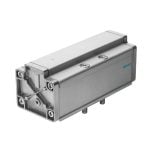 Valve technology overview
Designs, actuation and selection of pneumatic and hydraulic valves.
Read the guideHow do you calculate the required Kv value?
For liquids the simplified formula is Kv = Q x square root of (density ratio / pressure drop). For water this reduces to Kv = Q / square root of Delta p, with Q in m³/h and Delta p in bar. From the desired flow and the permissible pressure loss you obtain the required Kv value directly.
Example: if 8 m³/h of water are needed at a permissible pressure drop of 0.5 bar, then Kv = 8 / square root of 0.5 = 11.3. Select a valve with the next larger standard Kvs value so that reserve remains.
- Gases and steam use their own formulas with compressibility and the critical pressure ratio.
- For compressed air the flow is often given in normal litres per minute (Nl/min) or as the C and b values to ISO 6358.
- Always base the calculation on the worst case (maximum flow, minimum inlet pressure).
How are Kv value and nominal size related?
The nominal size DN describes the connection diameter of the valve, not directly its flow. Two valves of the same nominal size can have clearly different Kv values depending on design and internal geometry. For sizing the Kv value is therefore decisive, while the nominal size serves to match the pipe.
A rough rule of thumb: the flow velocity in the valve should not exceed about 2 to 4 m/s for liquids and 6 to 20 m/s for compressed air depending on the network. Nominal sizes that are too small cause noise, cavitation and pressure loss; sizes that are too large make the installation needlessly expensive.
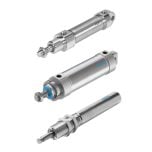 Sizing a compressed air network
Dimension pipe cross section, pressure loss and consumption correctly.
View productsFrequently asked questions
What is the difference between Kv and Kvs?
The Kv value applies to a specific opening degree, while the Kvs value is the maximum Kv value with the valve fully open. For sizing you compare the calculated required Kv with the Kvs stated by the manufacturer.
How do I convert Cv to Kv?
The relation is Kv = 0.86 x Cv and conversely Cv = 1.16 x Kv. The Cv value is based on US units (gallon/min at 1 psi), the Kv value on metric units (m³/h at 1 bar).
Why should the valve not be sized for full load?
A valve that constantly runs almost closed or fully open has no control reserve. A design point at about 20 to 80 % of travel ensures stable control and longer service life.
Does nominal size determine the flow?
No. The nominal size DN only describes the connection diameter. What determines the flow is the Kv value, which also depends on design and internal geometry.
Looking for the right valve?
We help you size by Kv value and nominal size and supply pneumatic and hydraulic valves for any flow - verified to IEC 60534.
Standard compliant
Kv values determined to IEC 60534.
Correctly sized
We work through your operating point.
Wide selection
Valves from DN 8 to DN 100 available.
Selection help
We help you choose the right products; technical details are clarified with the manufacturer.