
How do I choose a quick coupling for compressed air?
A quick coupling connects and disconnects air lines in seconds without tools. What matters is the nominal size and profile - they set the flow - plus the connection thread, one-hand operation, a venting safety coupling and the material. The profile must match your existing plugs.
View quick couplingsWhat does a compressed-air quick coupling do?
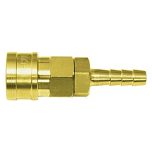
A quick coupling connects air lines and tools in seconds without tools: push the plug (nipple) in and the coupling locks; to release, pull back the sleeve. It has two parts - the coupling with a spring-loaded lock and the matching plug. Both sides must share the same profile.
The connection to the line itself is made with matching fittings - see Pneumatic fittings.
Which criteria set the nominal size and connection?
The nominal size and the profile decide how much air the coupling passes. Large consumers such as impact wrenches need a larger nominal size so the flow does not collapse. Add the connection thread or hose barb in the right size and the material.
| Nominal size | Flow | Typical use |
|---|---|---|
| NW 5 | low | blow guns, small tools |
| NW 7.2 (standard) | medium | general air tools |
| NW 7.6 | high | air-hungry tools |
| NW 10 and larger | very high | impact wrenches, several consumers |
What do one-hand operation and a safety coupling add?
A one-hand quick coupling couples and releases with a single grip - handy for frequent tool changes. A safety coupling vents the line before the final disconnect: the plug is unlocked first and the residual pressure is released in a controlled way, only then does the connection release.
| Material | Property | Use |
|---|---|---|
| Brass | robust, low corrosion | standard in workshop and industry |
| Steel / zinc-plated | very durable | harsh environments, high load |
| Composite | lightweight | hand-held tools, low weight |
Frequently asked questions
How do I know if a plug fits my coupling?
The profile is decisive. Plug and coupling must belong to the same coupling system. If the profiles differ, the plug will not lock tight. When in doubt, check your existing system or the manufacturer's data.
Which nominal size do I need?
The nominal size follows the tool's air demand. NW 7.2 is the standard for general tools. Air-hungry consumers such as impact wrenches need NW 7.6, 10 or larger so the flow does not collapse.
What is a safety coupling?
A safety coupling vents the line before disconnecting. The residual pressure is released in a controlled way before the plug releases. This prevents the plug from snapping back and stops hose whip.
The right quick coupling for your compressed air
Couplings and plugs in the matching profile, the right nominal size and with a safety function - matched to your tools.
Matching profiles
Couplings and plugs in one coordinated system.
Reviewed
Content reviewed by pneumatics specialists.
Full range
Couplings, plugs and accessories from one source.
Selection help
We help you choose the right products; technical details are clarified with the manufacturer.