
How to combine an air service unit (FRL) correctly?
The service unit conditions compressed air right before the machine: it filters dirt and condensate, holds the pressure steady and lubricates when needed. This guide explains the correct filter-regulator-lubricator order, sizing by flow rate and port size, and ongoing maintenance.
View service unitsContents
What does an air service unit consist of?
A service unit combines three parts in a fixed order: filter, pressure regulator and an optional lubricator (filter-regulator-lubricator, FRL). Air always flows through the filter first, then the regulator and finally the lubricator.
This order is mandatory: the filter removes condensate and particles before they reach the sensitive regulator seat. The regulator keeps the pressure constant, and only then does the lubricator add a fine oil mist that must not be filtered back out.
- Filter: separates condensate and particles, standard grade 5 to 40 µm.
- Regulator: keeps the secondary pressure steady despite line fluctuations.
- Lubricator: meters oil mist for tools and non-lubricated valves.
- Shut-off valve and gauge for maintenance and monitoring.
How do I size port and flow rate?
What matters is not the thread size but the required flow rate in l/min at an acceptable pressure drop. An undersized unit creates a high pressure drop, the machine gets too little air and the regulated pressure collapses.
Add up the air demand of all consumers running at the same time and add roughly 30 % reserve. Check the nominal flow of the service unit, which is usually stated at 6 bar inlet and 1 bar pressure drop.
- Determine the working pressure of the consumers, usually 6 to 8 bar.
- Sum the air consumption during simultaneous operation.
- Plan about 30 % reserve for peaks and contamination.
- Match filter grade to sensitivity: 40 µm general, 5 µm for valves.
Which features fit my application?
Beyond size and flow, the condensate drain, filter stage and bowl material decide the right unit. A semi-automatic drain opens on its own when depressurised, while an automatic drain empties during operation without any action.
Paint lines or measurement equipment require oil-free, dry air. Then a fine filter of 0.01 µm and an activated-carbon filter follow the standard filter, and never a lubricator. Polycarbonate bowls are inexpensive, but in harsh environments metal bowls with a guard are safer.
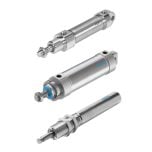
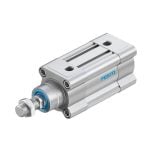 Selecting pneumatic cylinders
Matching cylinders and their air demand for your service unit.
View productsHow is the service unit maintained?
Regularly check the condensate level in the filter bowl and drain it before it reaches the baffle. Clogged filter elements raise the pressure drop and are replaced roughly once a year depending on load.
- Drain condensate daily or via an automatic drain.
- Inspect and replace the filter element when pressure drop rises.
- Check the lubricator level and refill only approved pneumatic oil.
- Verify the gauge and regulator setting periodically.
Frequently asked questions
In what order are filter, regulator and lubricator arranged?
Always filter, then regulator, then lubricator in the direction of flow. This way clean, pressure-stable air reaches the lubricator and the oil mist is not filtered back out.
Do I always need a lubricator?
No. Many modern valves and cylinders are lubricated for life. A lubricator is only needed when tools or older actuators require it, and oil-free applications work without one entirely.
How large should the service unit be?
The deciding factor is the flow rate in l/min at an acceptable pressure drop, not the thread size. Sum the air demand of all simultaneous consumers and add about 30 % reserve.
What working pressure do I set on the regulator?
Usually 6 to 8 bar, depending on the consumers. Set the regulator to the pressure actually needed, since a lower pressure saves noticeable energy.
Looking for the right service unit?
We supply filters, regulators and lubricators individually or combined as an FRL unit - sized to your flow rate and working pressure.
Correctly sized
Selected by flow rate, not just by thread.
Pressure stable
Regulators keep the working pressure constant.
Clean air
Filters reliably remove condensate and particles.
Selection help
We help you choose the right products; technical details are clarified with the manufacturer.