
How to find compressed air leaks with ultrasound?
Compressed air is the most expensive energy carrier on the shop floor, and leaks often waste 20 to 30 percent of what the compressor produces. This guide shows how to locate leaks reliably with a 40 kHz ultrasonic detector, how to convert each leak into annual energy cost, and how to set a sensible inspection interval.
Contents
Why do leaks give themselves away with ultrasound?
When compressed air escapes through a small opening it forms turbulence that generates broadband noise - well above the range of human hearing. Exactly this ultrasonic content around 40 kHz can be picked up by a detector, while it is barely masked by loud machine noise in the audible band.
The instrument converts the high-frequency signal into audible hiss using a heterodyne method. The closer the probe gets to the leak, the louder and sharper the signal becomes, so the spot can be narrowed down to a few centimetres.
- Audible production noise barely disturbs the measurement.
- Even tiny leaks of a few litres per minute are detected.
- Suitable for couplings, hoses, valves, fittings and service units.
- Measurement is possible during operation without shutting the network down.
How do you carry out a leak survey?
A systematic walk-through delivers the best results. Work the network from the compressor station along the main line down to the individual consumers, and record each leak with location, signal strength and estimated size.
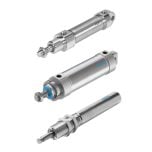 Compressed air metering
Matching ultrasonic leak detectors and flow meters for your network.
Read the guideHow do you assess the energy losses?
The loss depends on hole size and line pressure. At 6 bar a 1 mm opening lets out around 1 l/s, a 3 mm hole already ten times as much. Convert the air loss into electricity cost, since roughly 0.10 to 0.12 kWh are needed for every cubic metre of compressed air produced.
The figures assume continuous operation and an electricity price around EUR 0.20/kWh. Even a handful of medium leaks quickly add up to a four-figure sum per year - the ultrasonic detector usually pays for itself within a few months.
How often should the network be inspected?
A compressed air network ages: seals fatigue, couplings work loose, new connections are added. A leak check should therefore not be a one-off but anchored as a recurring measure in energy management to ISO 50001.
- Large or multi-shift plants: inspect at least every six months.
- Smaller workshops: an annual walk-through as a guideline.
- After rebuilds or new machines: a targeted follow-up check.
- Document repairs and offset the savings achieved.
Frequently asked questions
What frequency does an ultrasonic leak detector use?
Most instruments work around 40 kHz. In this band the flow noise of a leak is strong, while audible production noise barely disturbs the measurement.
Can I measure during operation?
Yes. The network stays pressurised and the machines keep running. It is exactly the operating state that makes the leaks audible, so no shutdown is required.
How much does a single leak cost?
A 1 mm opening at 6 bar costs around EUR 250 to 400 a year depending on the electricity price, a 3 mm leak quickly ten times as much. Several leaks soon add up to four-figure sums.
How quickly does an ultrasonic device pay off?
Because just a few repaired leaks translate into several thousand euros of savings, a detector typically pays for itself within a few months.
Track down and cut compressed air losses?
We supply ultrasonic leak detectors, focusing nozzles and flow meters for systematic leak surveys on your compressed air system.
Precise location
40 kHz detectors find leaks even in loud production.
Cost in view
Automatic conversion of loss into annual cost.
Field-proven
A method based on established energy management.
Selection help
We help you choose the right products; technical details are clarified with the manufacturer.