
Cylinder position sensors: how to choose, mount and adjust
Cylinder position sensors detect the piston position of a pneumatic cylinder without contact via the piston magnet. This guide shows how to pick the right sensor by groove profile and switching principle, mount it in the groove and adjust the end position precisely.
View position sensorsContents
Which position sensor fits my cylinder?
Cylinder position sensors detect the permanent magnet built into the piston and signal whether the cylinder has reached the front or rear end position. Selection comes down to three criteria: the groove profile of the barrel, the switching principle and the electrical output.
There are two switching designs. The reed switch uses a magnetically operated contact, is inexpensive and can switch AC, but has a mechanical contact with limited service life. The magnetoresistive sensor (MR, often called Hall) switches electronically with no wear, is bounce-free and allows high switching frequencies.
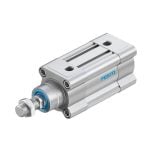
What groove profile does my cylinder have?
The sensor housing must match the groove in the cylinder body. Common profiles are the T-slot, the C-slot and the round groove (tie-rod cylinders). Each groove has its own clamp or slide-in mechanism.
- T-slot: the sensor drops in from above and is clamped with a screw - easy to fit and repositionable.
- C-slot: the sensor slides into the side channel and is fixed with a small grub screw.
- Round groove / tie-rod cylinder: fixed with a mounting band or clamp bracket around the barrel.
- Adapters let you fit a sensor of a different form factor into an existing groove.
Also consider cable exit and overall height. In tight machinery a low-profile sensor that sits flush in the groove with a side cable exit is often the only collision-free option.
How do I mount and adjust the sensor correctly?
Adjustment decides whether end sensing is reliable. First drive the cylinder to the end position you want to sense, then slide the sensor along the groove and find the point where the switching LED lights up dependably.
- Depressurise the cylinder and move it mechanically to the desired end position.
- Lay the sensor loosely in the groove and slide it slowly until the LED switches on reliably.
- Scan the range: mark LED-on and LED-off, then set the sensor to the centre of the switching window.
- Tighten the clamp screw to the specified torque - do not overtighten or the housing can crack.
- Cycle the end position a few times and verify the switching signal at the controller.
The output type matters when wiring. PNP switches the positive line (high-side), NPN switches ground (low-side) - the type must match your controller input. Two-wire versions are wired in series like a switch; three-wire sensors have separate supply and signal lines.
Frequently asked questions
Reed or magnetoresistive - which should I choose?
Reed switches are inexpensive and can switch AC but wear mechanically. Magnetoresistive sensors switch electronically without wear and bounce-free, ideal for high cycle rates and continuous duty.
What do PNP and NPN mean on a position sensor?
PNP switches the positive line (high-side), NPN switches ground (low-side). The output type must match the digital input of your controller, otherwise the signal is not detected.
Why does my sensor not react?
Common causes: the cylinder has no piston magnet, the sensor sits on the switching edge instead of the window centre, or the form factor does not match the groove. Check the LED first while sliding the sensor slowly.
Can I fit a sensor into any groove?
No. T-slot, C-slot and round grooves have different profiles. Choose the sensor to match the cylinder series or use an approved adapter.
Looking for the right position sensor?
We supply reed and magnetoresistive sensors for T-slot, C-slot and tie-rod cylinders - with PNP or NPN output and a matching connector.
For every groove
T-slot, C-slot and round groove from stock.
PNP and NPN
Matching output for any controller.
Tested
Switch point and service life per manufacturer spec.
Selection help
We help you choose the right products; technical details are clarified with the manufacturer.