
How to Set End-of-Stroke Cushioning on a Pneumatic Cylinder
End-of-stroke cushioning decelerates the piston just before it hits the end cap and prevents hard impacts. This guide explains how to adjust the cushioning screw step by step, how to estimate the kinetic energy and when pneumatic cushioning is no longer enough so an external shock absorber is needed.
View pneumatic cylindersHow does end-of-stroke cushioning work?
Pneumatic end-of-stroke cushioning catches the piston just before the end position. A cushioning spud seals off the normal exhaust path so the remaining air can only escape through an adjustable needle valve. The resulting air cushion brakes the piston gently.
Without cushioning the piston slams into the end cap at full force. This creates noise, vibration and, over time, fatigue at the end caps and mountings. Correctly set cushioning noticeably extends the service life of the cylinder.
- Elastic buffers: simple, maintenance-free, but only for small masses and low speed.
- Adjustable air cushioning: set via a needle valve, the standard on ISO 15552 profile cylinders.
- Self-adjusting cushioning: adapts automatically to changing loads, no manual re-tuning.
How do you set the cushioning screw correctly?
The basic rule: start with the needle valve almost fully closed, then open it in small steps. This way you brake hard at first and release the cushioning only until the piston reaches the end position softly but reliably.
- Bring operating pressure and load to real working conditions before adjusting.
- Always set both end positions separately, they have their own needle valves.
- Run several cycles after adjusting and re-check the result.
- Do not forget the lock nut so the screw does not drift under vibration.
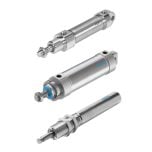
When is cushioning not enough and when do you need shock absorbers?
Built-in air cushioning only absorbs a limited share of the kinetic energy. As a rule of thumb: if the cylinder moves more than roughly 80 to 90 percent of its rated payload or travels faster than about 0.5 to 1 m/s, internal cushioning reaches its limit.
Kinetic energy rises with the square of speed: E = ½ · m · v². Double the speed and the energy quadruples. This is exactly where hydraulic shock absorbers come in. They convert the energy into heat via an oil fill and decelerate almost linearly over the whole stroke instead of only in the last few millimetres.
- High masses or high speeds: external shock absorber instead of internal cushioning.
- Precise, repeatable end position required: hard stop plus shock absorber.
- Changing loads: self-adjusting (adaptive) shock absorber.
- Very small cylinders with low energy: elastic buffers are often enough.
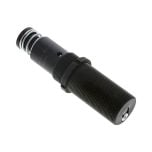 Industrial shock absorbers
Pick the right external damping for high energies and fast strokes.
View productsFrequently asked questions
Which way do I turn the cushioning screw?
Closing it (clockwise) increases cushioning, so the piston brakes earlier and harder. Opening it releases more exhaust air and softens the cushioning. Start almost closed and open in small steps.
How do I spot incorrectly set cushioning?
A hard, audible slam at the end position means the cushioning is too weak. If the piston bounces back or reaches the end position too slowly, the cushioning is set too strong.
When do I need an external shock absorber?
As soon as the moving mass or speed overwhelms the internal air cushioning, usually above about 80 to 90 percent of the payload or over roughly 1 m/s. A hydraulic shock absorber takes up the energy linearly over the stroke.
Do I have to set both end positions?
Yes. Extend and retract have their own needle valves and often different loads. Set each end position separately and secure the screw against vibration.
Looking for the right cylinder or shock absorber?
We supply pneumatic cylinders to ISO 15552 with adjustable cushioning and hydraulic shock absorbers for high energies.
Standard compliant
Cylinders to ISO 15552 with defined cushioning.
Correctly sized
Energy calculation for the right shock absorber choice.
Easy to adjust
Clear guidance for setting both end positions.
Selection help
We help you choose the right products; technical details are clarified with the manufacturer.