
Implementing an ESD control program: which steps, and what does missing protection cost?
An ESD control program to IEC 61340-5-1 is introduced in seven steps: appoint those responsible, survey the current state, define EPA boundaries, install basic equipment, train staff, set up a test plan and review key figures. Missing protection costs most through latent damage that appears at the customer as intermittent, hard-to-reproduce field failures.
View ESD protective equipmentContents
What does missing ESD protection cost a business?
The most expensive ESD damage is not the obvious catastrophic failure but latent degradation. A component survives the discharge, passes final test and fails weeks later at the customer. You then pay for returns, failure analysis, replacement and lost confidence, often without finding the cause, because the fault cannot be reproduced in the lab.
A discharge is a current pulse shorter than a nanosecond with peak currents in the ampere range. The local heating can melt oxide layers and fine conductor structures in modern semiconductors. People only feel a discharge from roughly 3000 V, while many components are damaged well below 100 V, so most harmful events go unnoticed.
Why is the damage so hard to prove?
- Catastrophic failure: found during test, causing scrap and rework.
- Parametric drift: higher leakage or shifted thresholds, still within tolerance.
- Latent defect: the weakened structure ages faster and fails in the field under heat or load.
- Intermittent fault: the returned unit shows no finding on the bench and is closed without a root cause.
What does IEC 61340-5-1 require from a control program?
IEC 61340-5-1 requires a documented program with administrative and technical requirements: a program plan, a training plan, a compliance verification plan and defined limits for grounding, personnel grounding, EPA equipment and packaging. It is designed for components that withstand a 100 V discharge in the Human Body Model (HBM).
The standard does not prescribe products, only properties that must be demonstrable. Parts below 100 V HBM or with high sensitivity under the Charged Device Model (CDM) need stricter measures. Requirements that do not apply to your process may be adapted, with the rationale recorded in the plan (tailoring). The verification plan itself is covered in the guide Building a compliance verification plan.
In which steps do you implement an ESD program?
A proven approach is seven consecutive steps: responsibility and survey first, then EPA boundaries and equipment, then training and test plan, finally key figures. Starting by buying mats without knowing processes and boundaries often means investing in the wrong place and leaving the real weak points open.
| Step | What is defined | Result |
|---|---|---|
| 1. Appoint those responsible | ESD coordinator with authority, management backing, members from production, quality, purchasing and maintenance | Written appointment, budget |
| 2. Survey and walk-through | Where sensitive parts are unpacked, processed, tested, stored and shipped, which insulators are present | Process map with weak points |
| 3. Define EPA boundaries | Areas, entrances, marking, most sensitive part as design basis | EPA layout plan |
| 4. Basic equipment | Personnel grounding, work surfaces, flooring, packaging, ionisation where needed | Accepted workstations |
| 5. Training | Initial training before access, refreshers at a fixed interval | Training records |
| 6. Test plan | Parameters, limits, methods, intervals, instruments | Test records |
| 7. Key figures and improvement | Test completion, deviations, audit findings, suspected ESD returns | Closed-loop actions |
Step 1 decides success. Without management backing, the program remains a recommendation that is dropped first under deadline pressure. The role is described in the guide ESD coordinator: role and duties.
What should you look for during the walk-through?
Follow a component from goods receipt to shipping. Note every point where it is handled, set down or moved unprotected, and every insulator within reach: plastic trays, films, tape dispensers, binders, personal items. The most sensitive part in use sets the protection level, not the average.
What basic equipment does the first EPA need?
Every EPA needs four basic elements: personnel grounding, dissipative and grounded work surfaces, suitable flooring where people move, and ESD packaging for transport and storage. Ionizers are added where essential insulators cannot be removed. IEC 61340-5-1 sets the limits for each element.
- Person to ground via wrist strap: < 3.5 x 10⁷ Ω, tested daily or continuously monitored.
- Work surface to ground (Rgp): < 109 Ω, each surface wired separately to the ground point, no daisy-chaining.
- Flooring with footwear as grounding path: person, footwear and floor < 109 Ω, grounders on both feet.
- Ionizer for essential insulators: offset voltage < ± 35 V at the workstation.
- Outside the EPA: parts only in closed, shielding packaging.
A single workstation with its grounding scheme is covered in the guide Setting up an EPA.
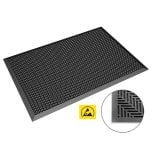 Personnel grounding and work surfaces
Wrist straps, table mats, ground points, flooring and packaging for basic equipment.
View productsHow does the program stay effective after rollout?
A program stays effective through three routines: recurring training, regular measurement to a fixed test plan and review of key figures. Without measurement every EPA degrades unnoticed: cords break, mats get dirty, ionizers drift, and new staff bring habits that nobody corrects until failures do.
Training before first access
Nobody enters the EPA without initial training covering the damage mechanism, use of the equipment, self-testing of personnel grounding and behaviour at the EPA boundary. Refreshers follow at a fixed interval and are recorded, see the guide ESD training.
Test plan and test equipment
The test plan defines parameter, method, limit and interval for each element. Basic equipment requires a resistance meter with electrodes to IEC 61340-2-3, a wrist strap and footwear tester, an ionizer test instrument and an outlet tester for the protective earth. What an audit covers is shown in the guide ESD audit and test plan.
Which key figures show success?
- Completion rate of scheduled tests.
- Share of measurements outside limits, by element.
- Open audit findings and time to closure.
- Internal failures and field returns with suspected ESD over time.
Frequently asked questions
Is an ESD control program a legal requirement?
No. IEC 61340-5-1 is a standard usually required by contract, for example by customers in automotive, medical or aerospace electronics. Companies processing electronic components still benefit from a documented program, because it reduces warranty risk even without a customer requirement.
Where do you start on a tight budget?
With responsibility, the walk-through and personnel grounding. Wrist straps with a tester, grounded work surfaces and shielding packaging cover the most frequent risks. Flooring, ionisation and continuous monitoring follow where the survey shows a need. Every measure is tested and recorded from day one.
How long does implementation take?
That depends on the size and number of areas. A single work area can be equipped and accepted within a few weeks. A whole site is usually converted area by area, starting where the most sensitive parts are handled unprotected.
Who checks that the program is followed?
Internal audits are carried out by the ESD coordinator or a trained team member who does not assess their own area. External audits are performed by customers or certification bodies. Both rely on the documented plan, test records and training records.
Putting together basic equipment for your ESD program?
Personnel grounding, work surfaces, flooring, packaging and test equipment for implementation to IEC 61340-5-1.
Standards-based
Content based on IEC 61340-5-1.
Practical
Roadmap from walk-through to key figures.
Measurable
Limits and test intervals instead of assumptions.
Selection help
We help you choose the right products; technical details are clarified with the manufacturer.