
How to Choose a Pneumatic Rotary Actuator Correctly
A pneumatic rotary actuator turns compressed air into a limited rotary motion for valves, grippers and transfer units. This guide explains how to size the required torque with a safety factor, set the correct swing angle and pick the right design between rack-and-pinion and vane.
View rotary actuatorsHow does a pneumatic rotary actuator work?
A pneumatic rotary actuator converts the linear force of compressed air into a limited rotary movement. Two operating principles dominate the market: the rack-and-pinion design (piston and pinion) and the vane design (rotating vane).
In the rack-and-pinion actuator, one or two pistons push a rack that turns a pinion. This delivers torque that is constant across the full angle plus high rigidity. In the vane actuator, a single vane rotates directly inside a chamber - compact and light, but with a limited angle and usually no internal end-position cushioning.
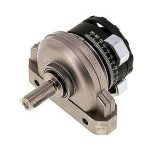 Actuate process valves
How to combine actuator, valve and sensors into a complete quarter-turn valve control.
Read the guideHow do I calculate the required torque?
Output torque rises linearly with operating pressure. Catalogue figures usually refer to 6 bar - at lower supply pressure the torque drops accordingly. The rule: determine the dynamic load torque plus friction and acceleration shares, then add a safety factor.
- Determine the load torque from weight, lever arm and friction of the driven part.
- Add the acceleration torque from inertia and the desired swing time.
- Convert to the real available supply pressure, not the 6 bar catalogue value.
- Apply a safety factor of 1.5 to 3 depending on the application.
- With spring return, check the weaker spring torque as the sizing limit.
Swing angle and design: what to watch
The swing angle must suit the process. Ball valves and dampers need 90 degrees, turnover units often 180 degrees, and special tasks use 270 degrees or freely adjustable end stops. Rack-and-pinion actuators offer mechanically adjustable stops depending on size, while vane actuators have a fixed range by design.
- Choose end-position cushioning when heavy masses are stopped abruptly - it protects the actuator and mounted parts.
- A mounting pattern to VDI/VDE 3845 (NAMUR) makes fitting valve and feedback sensors simple.
- Add proximity switches or a positioner if the position must be read electrically.
- Check the environment: stainless steel or anodised aluminium for wet, corrosive or food areas.
Frequently asked questions
Rack-and-pinion or vane actuator?
Rack-and-pinion actuators give constant, high torque across the full angle and absorb side loads - ideal for valves and handling. Vane actuators are lighter and more compact but limited in angle and less rigid.
What safety factor should I use on the torque?
For clean valves a factor of 1.5 is enough. For handling with inertia use 2.0, and for contaminated or fouling media use 2.5 to 3.0 against the break-out torque.
What happens if the air supply fails?
Double-acting actuators stay in their last position. Single-acting spring-return actuators move to a defined safe position, such as valve closed - this is the fail-safe function.
Why does the NAMUR interface matter?
The standardised mounting pattern to VDI/VDE 3845 allows direct, adapter-free fitting of valves and position feedback and makes the actuator interchangeable across brands.
Looking for the right rotary actuator?
We supply double- and single-acting rotary actuators in rack-and-pinion and vane designs with NAMUR mounting - matched to torque, angle and medium.
Correctly sized
Sizing to break-out torque with a safety factor.
Fail-safe option
Spring return for a defined safe position.
NAMUR mounting
Standard interface to VDI/VDE 3845.
Selection help
We help you choose the right products; technical details are clarified with the manufacturer.