
How do you size solder fume extraction correctly?
Solder fumes from rosin-based flux are considered respiratory sensitisers and must be captured at source. This guide explains the capture method, the airflow needed per workstation and the correct filter stages from pre-filter to activated carbon.
View fume extractionWhere must the solder fume be captured?
Solder fume rises as a hot buoyant plume directly above the tip. The most effective approach is capture at source: the nozzle or hood sits as close to the solder joint as possible so the fume is caught before it reaches the breathing zone.
There is point capture with a flexible nozzle at a single station and area capture of several stations through a ducted system. Distance is decisive: capture effectiveness falls with the square of the distance, so the nozzle should sit no more than 5 to 10 cm from the joint.
- Point extraction with gooseneck nozzle: ideal for individual hand-soldering stations.
- Funnel or slot hood: for wider work areas and several joints.
- Integrated tip extraction: thin tube on the iron itself, captures very close, needs little air.
- Avoid cross-draughts - moving air carries fume into the breathing zone.
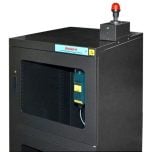 Workstation ventilation
How to plan supply and exhaust air at the ESD bench to standard.
Read the guideHow much airflow does a workstation need?
Airflow depends on capture method, nozzle cross-section and distance. A single hand-soldering station with close point extraction needs roughly 60 to 120 m³/h. Capture through an open hood at greater distance quickly pushes demand up to several hundred m³/h.
In a multi-station system the individual flows add up, and the duct cross-section must carry the total airflow at an acceptable pressure loss. Rule of thumb: air velocity in the collector duct of about 5 to 10 m/s so no condensate settles and the blower delivers the needed pressure.
Which filter stages does rosin require?
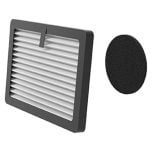
Rosin-based solder fume contains solid particles (an aerosol from the flux) and gaseous components. Multi-stage filtration is therefore mandatory: a pre-filter for coarse particles, an H13 (HEPA) particulate filter for the fine aerosols and an activated-carbon stage for the gaseous components and odours.
- Stage 1 - pre-filter (F7-F9): catches coarse particles and flux spatter, protecting the fine stage.
- Stage 2 - HEPA filter H13: retains at least 99.95 % of fine dust and fume particles.
- Stage 3 - activated carbon: adsorbs gaseous organic compounds and odours.
- Recirculation only with the full filter chain - otherwise gases return to the room.
Watch the filter change: the pre-filter is swapped most often, the carbon once saturated. A loading indicator or differential-pressure reading sets the timing. Loaded HEPA and carbon filters must be disposed of as contaminated waste.
Frequently asked questions
Why is rosin in solder fume hazardous?
Heating the flux creates aerosols of rosin resin that are classed as respiratory sensitisers and can trigger asthma. That is why the fume must be captured at source and filtered through an H13 stage.
How much airflow does a single hand-soldering station need?
With a close gooseneck nozzle at 5 to 10 cm distance, roughly 60 to 120 m³/h is enough. Integrated tip extraction on the iron gets by on 20 to 40 m³/h because capture is very close.
Is a simple particle filter enough?
No. Solder fume contains particles and gases. A pre-filter and an H13 particulate filter bind the aerosols, but only the activated-carbon stage adsorbs the gaseous components and odours.
When should I change the filters?
As soon as the differential pressure rises or the loading indicator responds. The pre-filter most often, the carbon once saturated. Loaded HEPA and carbon filters count as contaminated waste.
Sizing solder fume extraction correctly?
We supply point and multi-station systems with a three-stage filter chain - sized to your airflow and to rosin-based solder fumes.
To standard
Capture in line with the requirements of DIN EN ISO 21904.
At the source
Nozzles close to the joint for minimal air demand.
Three-stage filtration
Pre-filter, H13 HEPA and activated carbon in one system.
Selection help
We help you choose the right products; technical details are clarified with the manufacturer.