
How to size local exhaust ventilation for hazards?
Local exhaust ventilation captures hazardous substances right where they arise, before they reach the breathing zone. This guide explains capture elements, the minimum capture velocity you need and how to choose the right filter in line with TRGS 528 and TRGS 900.
View extraction unitsHow does local exhaust capture hazards?
Local exhaust ventilation draws off fumes, vapours and dust directly at the point of release, while the contaminant cloud is still small and directed. Under the STOP hierarchy of the hazardous substances rules, this source capture takes priority over general room ventilation because it removes the substance before it dilutes and spreads.
The capture element is the interface to the source: a hood, slot, flanged nozzle or a flexible extraction arm. The distance to the source is decisive, because capture velocity falls with the square of the distance. Double the distance and the effect drops to roughly a quarter.
- Articulated extraction arms: freely positioned for changing soldering and welding stations.
- Slot and rim extraction: for tanks, dip baths and troughs releasing solvents.
- Flanged and cone hoods: focus the flow and extend reach compared with a free nozzle.
- Enclosures: the best capture wherever the process can be physically enclosed.
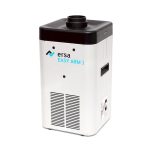
What minimum capture velocity is required?
What matters is the capture velocity at the source, not the speed inside the duct. It has to exceed the motion of the contaminant so the cloud is pulled reliably into the hood. For near-still release about 0.25 to 0.5 m/s is enough, while moving room air or active ejection calls for 0.5 to 1.0 m/s and more.
Capture velocity and the capture area together give the required volume flow in m³/h. Inside the ducts you also need a minimum transport velocity so dust does not settle: typically 18‑20 m/s for fine dry dust and up to 25 m/s for heavy or moist particles.
Which filter suits the hazardous substance?
Filter choice follows the type of hazard: particles need a mechanical particulate filter, gases and vapours need activated carbon. For carcinogenic or very fine fumes, such as welding alloyed steels, HEPA filters of class H13 to EN 1822 are state of the art.
- Pre-filters (G/M/F): trap coarse dust and protect the costly main filter.
- HEPA H13/H14: for respirable and carcinogenic dust and welding fumes.
- Activated carbon: for solvent vapours and organic odours, exhausted once loaded.
- Combination filters: multi-stage for mixed emissions of particles and vapours.
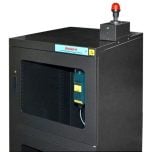 Understanding filter classes
From G pre-filter to H14 - which class your process needs.
Read the guideFrequently asked questions
What does TRGS 528 cover?
TRGS 528 sets out protective measures for welding operations. It requires effective capture at the source for hazards such as carcinogenic welding fumes and governs when extracted air may be recirculated.
What is the purpose of TRGS 900?
TRGS 900 defines the occupational exposure limits (OEL) for hazardous substances in workplace air. These values are the benchmark for whether an extraction system works well enough and whether cleaned air may be returned.
How close must the extraction arm be?
As close as possible, ideally under 30 cm. Capture velocity falls with the square of the distance, so doubling the gap alone cuts the effect to a quarter.
Can cleaned air return to the room?
Only if cleaning stays safely below the limit values of TRGS 900. For carcinogenic substances TRGS 528 generally requires discharge outdoors or a tested recirculation procedure.
Looking for local exhaust for your process?
We supply extraction arms, filter units and capture elements - sized to TRGS 528 and TRGS 900 for soldering, welding and dust processes.
Sized to TRGS
Capture and filtration meet TRGS 528 and 900.
Captured at source
Extraction arms take capture right to the source.
Measurably effective
Volume flow and limit values documented and verifiable.
Selection help
We help you choose the right products; technical details are clarified with the manufacturer.