
Air consumption calculation - how many normal litres does the system need?
Anyone running cylinders and air tools needs the consumption in normal litres to size the compressor and piping correctly. This guide shows the formula with the compression ratio, how to convert Nl/min to m³/h and the margin to add for reserve.
View pneumaticsWhy is compressed air measured in normal litres?
Compressed air is a compressed gas, so its volume depends on pressure. To make figures comparable, consumption is referred to the normal state: under DIN 1343 that is 0 °C and 1013.25 mbar. A normal litre (Nl) is therefore the amount of air that fills one litre at this state.
A cylinder working at 6 bar gauge draws about seven normal litres for every litre of cylinder volume. The reason is the compression ratio: at 6 bar it is roughly (6 + 1.013) / 1.013 = 6.9. Ignore it and you underestimate demand by a factor of six.
- Nl (normal litre): volume at the normal state 0 °C / 1013 mbar.
- Nl/min: the usual flow figure for tools and valves.
- m³/h: compressor delivery (free air delivery, FAD).
- Conversion: 1 m³/h equals 16.7 Nl/min.
How do you calculate a cylinder's consumption?
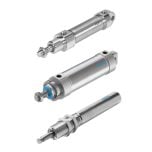
A cylinder's air demand is the swept volume times the stroke frequency times the compression ratio. For a double-acting cylinder both the extend and retract strokes count, with the piston rod taking a little area off the rear side.
Formula per double stroke: Q = (π/4 · D² · s) · 2 · n · (p + 1.013) / 1.013, with bore D, stroke s, cycle rate n and working pressure p in bar. Example: D = 32 mm, s = 100 mm, 30 double strokes/min at 6 bar give about 0.08 dm³ swept volume · 2 · 30 · 6.9 = roughly 33 Nl/min.
What do tools use and how do you size piping?
Air tools state their consumption directly in Nl/min or m³/min, usually referenced to 6.3 bar. These values apply to continuous running. Because a driver or chisel does not run permanently, you apply a duty cycle factor, often 20 to 50 percent.
- Air impact wrench: approx. 300‑500 Nl/min at 6.3 bar.
- Blow gun: approx. 150‑300 Nl/min, strongly nozzle-dependent.
- Random orbital sander: approx. 350‑600 Nl/min continuous.
- Chisel hammer: approx. 200‑400 Nl/min, high peak demand.
- Real demand = rated value · duty cycle per tool.
The sum of all consumers running at the same time gives the system demand. On top you add 20 to 30 percent reserve for leaks, future expansion and efficiency losses. Piping should be sized so the pressure drop stays below 0.1 bar per 10 m - hoses that are too thin cost pressure and therefore power at the tool.
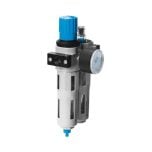 Air preparation units
Filters, regulators and lubricators for a stable working pressure.
View productsFrequently asked questions
What is a normal litre?
A normal litre (Nl) is the amount of air that fills one litre at the normal state per DIN 1343 - 0 °C and 1013.25 mbar. It lets you compare consumption independently of working pressure.
How do I convert Nl/min to m³/h?
Multiply Nl/min by 60 and divide by 1000. So 33 Nl/min is about 2 m³/h. Conversely, 1 m³/h equals about 16.7 Nl/min.
How much reserve does the compressor need?
Add 20 to 30 percent to the sum of all simultaneously running consumers. That covers leaks, efficiency losses and later expansion.
Why does working pressure matter so much?
Consumption rises linearly with the compression ratio (p + 1.013) / 1.013. At 6 bar it is 6.9, at 8 bar already 8.9 - every extra bar costs noticeable air and energy.
Sizing your system correctly?
We supply cylinders, valves, tools and air preparation units with clear consumption figures in normal litres - for a robust design.
Clear reference
Consumption figures to the DIN 1343 normal state.
Verifiable
Formulas and examples for a robust design.
Reserve included
Recommendation with 20 to 30 percent safety margin.
Selection help
We help you choose the right products; technical details are clarified with the manufacturer.