
Small-parts cabinets and drawer systems: how do you organise small parts clearly?
A small-parts cabinet groups many small drawers in one compact housing. Dividers split each drawer into compartments, and transparent fronts show the contents at a glance. Screws, terminals and components stay sorted, labelled and within reach - on the wall, on the bench or on a stand.
View small-parts cabinetsHow is a small-parts cabinet built?
A small-parts cabinet is a housing with many individually pull-out drawers. Each drawer can be split into smaller compartments with dividers or inserts. Transparent drawer fronts reveal the contents without opening - that saves searching and keeps small ranges in order.
Drawers come in different heights and widths: shallow drawers for screws, terminals and resistors, deeper ones for connectors or small tools. Label strips on the front assign a clear content to each compartment.
Which drawer size suits which use?
The right drawer size follows part size and quantity. Shallow drawers with many dividers hold the smallest standard parts, while tall drawers take bulkier items. The overview below maps typical configurations to their use.
| Drawer / configuration | Typical parts | Use |
|---|---|---|
| shallow, many divided compartments | screws, nuts, resistors | separate tiny parts by type |
| medium, few compartments | terminals, fuses, diodes | mixed C-parts range |
| tall, undivided | connectors, small tools | bulkier single items |
| ESD version, dissipative | ICs, boards, components | electronic components |
| labelled fronts | any C-parts store | fast picking |
For electronic components an ESD version is advisable: housing and drawers are dissipative so no static charge builds up that could damage sensitive parts. Where only mechanical small parts are stored, the standard version is enough.
Small-parts cabinet or open storage bin - what is the difference?
Open storage bins are quickly accessible and ideal for constant reach at the shelf wall. A closed small-parts cabinet, by contrast, protects the contents from dust, holds many types in a small footprint and offers finer subdivision with dividers.
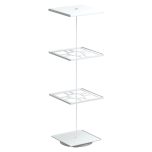 Placement
As a bench-top unit, wall-mounted or on a stand - to suit the workplace and the space available.
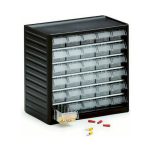 Overview
Transparent fronts and label strips show contents and fill level without opening every drawer.
Closed drawers keep sensitive parts clean - unlike open bins.
The two systems complement each other: the open storage bin serves fast reach on the shelf, while the small-parts cabinet groups many small types, protected and labelled, at the workplace. Which layout and version fits depends on your part range - questions? Send us a message.
Frequently asked questions
What is a small-parts cabinet suited to?
For many small types in little space: screws, terminals, fuses and electronic components. Dividers split the drawers, and transparent fronts with labelling make every part quick to find.
When do you need an ESD version?
As soon as electronic components such as ICs or boards are stored. In the ESD version, housing and drawers are dissipative so no static charge builds up that could damage sensitive parts.
How is a small-parts cabinet placed?
Depending on space, as a bench-top unit, wall-mounted or on a stand. That lets it fit flexibly into the workplace, the lab or the workshop.
Small-parts cabinets for workshop, lab and electronics
Many drawers with dividers, transparent fronts, labelling and an ESD version for sensitive components.
Clear overview
Transparent fronts and labelling make every compartment unambiguous.
Reviewed
Content reviewed by storage specialists.
ESD-safe
Dissipative version for electronic components.
Selection help
We help you choose the right products; technical details are clarified with the manufacturer.