
How to Choose and Connect an ESD Ground Bus Bar
The ESD ground bus bar is the central node where table mats, wrist straps and tools are all brought to earth together. This guide covers the common point ground per IEC 61340-5-1, how to select the bar, and how to wire it correctly using 1 MΩ resistors.
View ESD grounding gearWhat is an ESD ground bus bar?
An ESD ground bus bar is a conductive metal rail, usually anodised aluminium or brass, that acts as the common point ground at a workstation. Every dissipative element - table mat, floor mat, wrist strap and tools - is connected in a star pattern to this single bar.
The rule is simple: one workstation, one ground point. This keeps all components at the same potential, so there are no potential differences where sensitive parts could discharge. The bar itself has a very low internal resistance of under 1 Ω to the protective earth conductor.
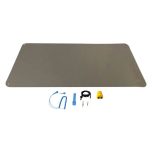
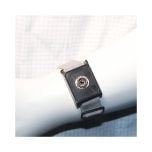
Which bar suits which workstation?
The key factors are the number of connections, the snap fastener standard and the mounting concept. Typical bars offer 3 to 8 snap studs in the 10 mm standard size plus a terminal or banana socket for the earth lead to the protective conductor.
- Match the number of studs to the mats, straps and tools present, with spare capacity.
- Always connect people (wrist straps) through a 1 MΩ resistor, usually built into the coil cord.
- Dissipative mats need no extra MΩ element; they are contacted directly.
- Ensure a secure, permanently low-resistance link between the bar and the building PE.
How do you wire the ground bar correctly?
Wiring follows a star topology: exactly one lead runs from each element to the bar, and one earth lead runs from the bar to the protective conductor. This keeps the ground path clear and testable.
- Mount the bar at the bench edge (clamp or screw) with a clean, bare contact area.
- Route the earth lead from the bar to the PE point: a mains earth plug or fixed PE terminal, with no added resistor.
- Connect the table mat directly via snap stud and earth cord.
- Attach the wrist strap through the coil cord with its integrated 1 MΩ resistor.
- Bond tools and shelving as dissipative items, each with its own lead to the bar.
- After assembly measure continuity: bar to PE under 1 Ω, person path in the MΩ range.
Frequently asked questions
Why do I need a common point ground?
So every ESD component at a workstation sits at the same potential. Per IEC 61340‑5‑1 the single ground point prevents potential differences that could damage parts.
Does a resistor belong between the bar and the protective earth?
No. The bar is bonded to PE without an added resistor. The 1 MΩ resistor only sits in the person connection, that is, in the wrist strap.
How many connections should the bar have?
Enough that the table mat, wrist strap and every tool get their own lead, plus some spare. For a single station 3 to 4 snap studs are usually enough.
Can several workstations share one bar?
Each station should have its own common point ground. Multiple points are led back to the same building protective earth centrally, not chained in series.
Looking for a ground bar for your ESD bench?
We supply ground bus bars, common point grounds and matching leads with a 1 MΩ resistor - tested to IEC 61340-5-1.
Standard tested
Grounding hardware to IEC 61340-5-1.
One ground point
Star topology for one clear ground path.
Measurably safe
Continuity to PE documented and testable.
Selection help
We help you choose the right products; technical details are clarified with the manufacturer.