
Cleaning ESD Mats Without Destroying Their Dissipation
The wrong cleaner leaves an insulating film that permanently kills a mat's dissipation. This guide shows which dissipative ESD cleaners keep bench and floor mats working, which products are off limits, and how to verify surface resistance to IEC 61340-5-1.
View ESD cleanersContents
Why do the wrong cleaners destroy dissipation?
The surface of an ESD mat must carry charge to ground in a controlled way. Ordinary household and glass cleaners often contain silicones, oils, waxes or plasticisers that leave a thin insulating film. That film lifts the surface resistance above the permitted band, so the mat can no longer safely drain static charge.
The trap is that the damage is invisible and can barely be wiped off again with a normal cloth. After a few wrong cleanings the mat suddenly measures over 10¹¹ Ω and fails the test even though it looks perfectly clean.
- Silicone forms a permanent insulating, water-repellent film.
- Oils and waxes from furniture polish degrade the path to ground.
- Aggressive solvents such as acetone attack the dissipative top layer.
- Surfactant residues can also shift the resistance out of range.
What is the correct way to clean ESD mats?
Use only dissipative ESD cleaners that are formulated silicone- and oil-free. They dissolve flux, finger grease and dust without leaving an insulating layer, keeping the surface resistance in the target band of 10⁶ to 10⁹ Ω.
- Apply cleaner to a soft, lint-free cloth rather than spraying the mat directly.
- Wipe in overlapping paths and dry off with a clean cloth.
- For daily interim cleaning a slightly damp microfibre cloth is usually enough.
- Let the mat dry fully before placing components back on it.
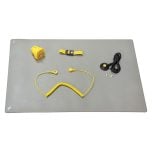
What matters most with floor mats?
Floor mats face higher mechanical load, shoe dirt and cleaning machines. Scrubber-dryers and floor cleaners often contain gloss additives or refatting agents that insulate the covering. So use dissipative cleaning agents on the floor as well.
- Sweep or vacuum coarse dirt dry first, then wipe damp.
- Dose a dissipative mopping cleaner heavily diluted per the maker's spec.
- Do not treat with floor wax, gloss emulsion or refatting agents.
- Keep grounding points and earth tabs clean and free of coating.
How do you verify and document success?
Cleaning without a check is flying blind. Measure the surface resistance regularly with an ESD tester against the grounding point and record the values. That way you catch a creeping rise from wrong cleaners before the mat fails when it matters.
Frequently asked questions
Can I clean ESD mats with glass cleaner?
No. Glass and household cleaners usually contain silicones or surfactants that leave an insulating film and push the surface resistance above the permitted band. Use a silicone-free ESD cleaner instead.
How often should an ESD mat be cleaned?
At normal workstations a thorough clean once a week plus daily wiping is usually enough. At soldering benches with flux residue, clean more often so no insulating layer builds up.
Can a mat insulated by silicone be saved?
Sometimes. A silicone-free ESD cleaner can lift light films. If the surface resistance stays above 10⁹ Ω after repeated cleaning, the film is permanent and the mat should be replaced.
May I use isopropanol?
Diluted and for spot removal of flux, yes, but do not flood the surface. Pure acetone or other aggressive solvents attack the dissipative top layer and should be avoided.
Keep dissipation for the long run?
We supply silicone-free ESD cleaners and care products for bench and floor mats - matched to the requirements of IEC 61340-5-1.
Silicone-free
Cleaners without silicone, oil or plasticisers.
Standard-compliant
Keeps values to IEC 61340-5-1.
Measurably verified
Surface resistance testable and documentable.
Selection help
We help you choose the right products; technical details are clarified with the manufacturer.