
Continuous grounding monitoring instead of daily testing?
A continuous ground monitor watches the wrist strap - and often the bench mat too - in real time and alarms the moment a connection fails. It closes the gap between two daily tests, where a failure used to go unnoticed, and delivers a complete audit log.
View ESD protectionWhy monitor continuously instead of testing daily?
The daily test at a personnel tester proves grounding only at the moment of measurement. If the coil cord breaks or the contact loosens two hours later, the fault stays unnoticed until the next test - and every assembly built in that time is unprotected. A continuous monitor watches the connection permanently and alarms immediately.
Single-wire or dual-wire monitor - which is more reliable?
A single-wire monitor uses an ordinary coil cord and checks by impedance or capacitance whether the person is grounded. A dual-wire monitor measures the true loop resistance through a two-conductor cord and so detects creeping contact resistance more reliably - it needs a dual-wire coil cord for this.
| Feature | Single-wire monitor | Dual-wire monitor | Daily tester |
|---|---|---|---|
| Measuring principle | impedance / capacitance | true loop resistance | resistance, one point |
| Cord | single-wire coil cord | dual-wire coil cord | any |
| Monitoring | continuous | continuous | once a day |
| Reliability | good | higher | only at test time |
| Failure detected | immediately | immediately | at the next test |
Which straps are being monitored is explained in Wrist strap or heel strap.
When is continuous monitoring worthwhile or required?
Continuous monitoring pays off wherever an unnoticed grounding failure becomes expensive: on high-value or especially sensitive components and on critical assembly whose defects only surface later. The complete audit log doubles as proof for audits and traceability.
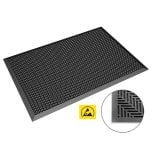 Critical assembly
Processes whose ESD damage only shows up in the field - every second of protection counts.
View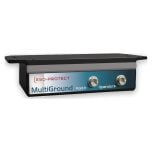 Audit evidence
Monitors with logging document grounding without gaps for customers and auditors.
View productsFrequently asked questions
Does a monitor replace the daily test?
In practice yes: with continuous monitoring you no longer need a separate daily test, because the monitor proves grounding permanently and reports any failure at once.
What exactly does a ground monitor watch?
Usually the person's wrist strap and often the dissipative bench mat as well. If either connection fails, the monitor gives a visual and audible alarm.
Why is the dual-wire monitor considered more reliable?
It measures the true loop resistance through two conductors instead of only impedance or capacitance. That lets it catch slowly rising contact resistance a single-wire system can miss.
Keep grounding under constant watch
Single-wire and dual-wire ground monitors, matching coil cords and personnel testers - from a single source.
Real-time protection
Grounding is watched permanently, not just by spot check.
Reviewed
Content reviewed by ESD specialists.
Full range
Monitors, cords and testers from a single source.
Selection help
We help you choose the right products; technical details are clarified with the manufacturer.