
ESD Workstation Monitor: Why Monitor Continuously?
A constant monitor checks the wrist strap and work mat continuously and raises an alarm the moment something fails. This guide explains how it works, the limit values under DIN EN 61340-5-1, and why continuous monitoring beats the periodic touch test.
View constant monitorsWhat does a constant monitor do at the workstation?
A constant monitor is a small instrument at the bench that permanently checks the resistance of the wrist strap and work mat to ground. If a value leaves the allowed window, the device instantly triggers a visual and audible alarm.
There are two designs. The single-wire monitor uses a standard wrist strap and a capacitive measurement, while the dual-wire monitor uses a two-conductor strap and measures the ground path directly. Dual-wire is considered the more robust principle because a break in one conductor is detected immediately.
- Continuous measurement every second instead of a spot check.
- Visual alarm (red LED) plus an audible signal.
- Separate channels for wrist strap and mat.
- Low-voltage supply, so no hazardous voltage reaches the strap.
 Wearing the wrist strap correctly
Fit, skin contact and testing of the grounding strap in detail.
View productsWhich limit values does the device monitor?
The monitor sets an upper and a lower window for each channel. If the strap is interrupted, resistance rises above the upper limit; a short circuit or damp contact drops it below the lower limit. Both cases mean the grounding no longer works to standard.
The base standard DIN EN 61340‑5‑1 requires grounding systems to be verified regularly. A constant monitor satisfies the need for ongoing control and logs faults in real time instead of revealing them only at the next scheduled test.
Why is monitoring better than the touch test?
With the classic touch test, an operator checks the wrist strap once per shift at a test unit. If the strap fails mid-shift, the fault stays undetected until the next check - and every component handled in that time is potentially at risk.
- Gap-free: faults are reported the instant they occur, not hours later.
- Traceable: the alarm shows exactly when grounding was lost.
- Less scrap: latent damage from unnoticed discharges drops.
- Less effort: no daily manual testing and logging per person.
- Behaviour-shaping: a visible alarm enforces correct strap use.
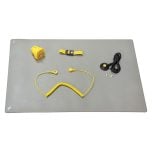 Choosing an ESD table mat
Construction, dissipation resistance and grounding of the work surface.
View products
Frequently asked questions
What is the difference between single-wire and dual-wire?
Single-wire uses a normal strap and a capacitive measurement; dual-wire uses a two-conductor strap with direct resistance measurement. Dual-wire detects a conductor break immediately and is therefore considered safer.
Does the monitor replace the daily touch test?
Usually yes. Because the device measures without interruption, the manual shift test is no longer needed at monitored benches. The limit values should still be verified periodically.
Is continuous monitoring mandated by the standard?
DIN EN 61340‑5‑1 requires regular verification but does not prescribe a specific method. A constant monitor is the most convenient way to deliver the required ongoing control.
Can one monitor check the mat and the strap together?
Yes, dual-channel units watch an operator channel and a mat channel separately and raise a dedicated alarm for each fault.
Looking for a constant monitor for your bench?
We supply single- and dual-wire monitors for wrist strap and mat, with visual and audible alarm, verified to DIN EN 61340-5-1.
Standard-verified
Monitoring in the spirit of DIN EN 61340-5-1.
Instant alarm
Visual and audible on the first fault.
Two channels
Operator and mat watched at once.
Selection help
We help you choose the right products; technical details are clarified with the manufacturer.