
How to choose water pump pliers for the job
Water pump pliers grip pipes, nuts and fittings through an adjustable jaw. This guide explains how to pick jaw capacity, the adjustment and locking mechanism and grip insulation for electronics and installation work, plus what matters in size and teeth.
View water pump pliersWhat jaw capacity and length do you need?
Jaw capacity decides how thick a pipe or how large a nut you can grip, while overall length sets the leverage. A 250 mm tool typically opens to around 50 mm, large 400 mm models grip pipes up to about 90 mm. For fine electronics and plumbing a compact 180 to 250 mm pair is usually enough.
Adjustment runs through several positions, often 9 to 27 steps. The finer the steps, the more parallel the jaw sits on the workpiece and the less it slips. For a well stocked tool case, two sizes make sense: a small one for tight spots and a large one for pipe work.
Which locking and adjustment mechanism fits?
Adjustment systems range from classic slip joints to push-button quick adjust and self-clamping designs. A good joint prevents the dreaded jaw spread under load, where the pliers slip and nuts or edges get rounded off.
- Groove-and-tongue joint: robust and affordable, adjusted by opening and repositioning the jaw.
- Push-button quick adjust: one-handed setting at the press of a button, ideal for repetitive work.
- Self-clamping teeth: bite harder the more you squeeze and barely slip.
- Lockable models with a latch hold the workpiece without constant hand pressure.
Handle geometry should stop the palm from being pinched. A stop or grip zone keeps the handle ends far enough apart when closing so no skin gets caught.
When do you need VDE insulated grips?
Whenever you work on or near live parts, insulated grips are mandatory. VDE-tested pliers to DIN EN 60900 are rated for work up to 1000 V AC and each one is individually tested at 10000 V. For electronics and installation work on de-energised circuits they add a clear margin of safety.
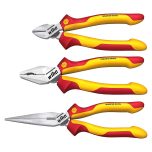 Pliers and cutters
Matching side cutters and combination pliers for the electronics bench.
View products
Frequently asked questions
What size water pump pliers for electronics?
For fine electronics and precision mechanics a compact 180 to 250 mm pair with a jaw capacity up to about 40 mm is enough. It sits well in the hand and reaches into tight enclosures.
What does push-button adjustment mean?
A button releases the joint so you can set the jaw capacity one-handed without opening and repositioning the jaw. It saves time when sizes change frequently.
Are VDE insulated grips always needed?
Only for work on or near live parts. For electrical installation, VDE pliers to DIN EN 60900 rated to 1000 V are mandatory, while purely mechanical use is fine with standard grips.
Why do my pliers slip off nuts?
Usually because the joint spreads under load or the teeth are worn. A self-clamping joint with hardened teeth keeps the jaws parallel and stops corners from being rounded off.
Looking for the right water pump pliers?
We supply water pump pliers in every length, with quick adjust and VDE insulated grips to DIN EN 60900 - for electronics and installation.
VDE tested
Insulated models to DIN EN 60900 up to 1000 V.
Non-slip grip
Hardened teeth bite while sparing edges.
Every size
From precision work to pipe fitting.
Selection help
We help you choose the right products; technical details are clarified with the manufacturer.