
Soldering flux: which types are there and how are they applied?
Flux chemically cleans the metal surfaces during soldering, removes oxide layers and improves how the solder wets the joint. This guide explains the common types, their forms, activity levels and when residues must be cleaned - including ESD-safe handling.
Explore solderingWhy do you need flux when soldering?
Flux removes the oxide layers from the solder and the workpiece and prevents new oxides from forming at soldering temperature. This lets the molten solder wet the metal surface evenly and form a mechanically and electrically sound joint. Without flux the solder beads up and the joint turns cold or porous.
Metal surfaces always carry a thin oxide film that solder cannot penetrate. Flux chemically reduces these oxides and lowers the surface tension, so the solder flows flat instead of pulling into balls. The result is visible as a shiny, concave joint.
Which flux types and forms are there?
The three common flux types are rosin (colophony), no-clean and water-soluble (organic acid) fluxes. They differ mainly in activity and residue behaviour. They are supplied as a flux core in solder wire, as a flux pen and as a gel or paste in a syringe for rework and SMD work.
- Flux core (wire): flux is enclosed in the solder wire and released as it melts - the standard for hand soldering.
- Flux pen: dosed application onto pads and leads before soldering, clean and drip-free.
- Gel/paste in a syringe: precise dosing for rework, SMD parts and re-wetting fine leads.
When must residues be cleaned and how do you handle flux ESD-safe?
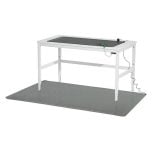
Residues must be removed when they are corrosive or electrically conductive - this applies to water-soluble and strongly activated rosin fluxes. No-clean residues are high-resistance and may usually stay in place. On ESD-sensitive assemblies the work is done at a grounded workstation with dissipative tools and cleaning agents.
- Water-soluble: always clean - residues are corrosive and attract moisture.
- Activated rosin (RA): clean to avoid corrosion and leakage currents.
- No-clean: residues may remain; still remove them for optical inspection or conformal coating.
- Visual check: a shiny, concave joint without beads or peaks indicates good wetting.
Frequently asked questions
Can you solder without flux?
In practice no: without flux the oxides stay on the surface, the solder does not wet and the joint turns cold or porous. That is why solder wire already contains a flux core.
Do I have to remove no-clean residues?
Usually not - no-clean residues are low, non-corrosive and high-resistance. For optical inspection, conformal coating or high cleanliness requirements they are removed nonetheless.
Why must water-soluble fluxes be cleaned?
Their residues are organic acids that act corrosively and attract moisture. Left on the assembly they risk corrosion and leakage currents. Cleaning is done with water.
The right flux and soldering accessories
From flux pen to ESD-safe soldering workstation - find the right choice for your application.
Selection help
We help you choose the right products; technical details are clarified with the manufacturer.
Selection help
We help you choose the right products; technical details are clarified with the manufacturer.
Brand neutral
Factual selection criteria without brand bias.
Selection help
We help you choose the right products; technical details are clarified with the manufacturer.