
Choosing soldering iron power: how many watts do I need?
More watts do not mean a hotter tip - the temperature stays at 350 to 380 °C. What matters is recovery: how fast the station replaces heat drawn into the joint. Large masses and ground planes need power, fine SMD needs precise control above all.
View soldering stationsWhy more watts do not mean a hotter tip
Power does not change the tip temperature - lead-free it sits at 350 to 380 °C, held constant by control. Watts set the thermal recovery: how fast the station replaces the heat drawn into the joint on contact. Higher power keeps the tip stable under load.
Which power fits which task?
As a rule of thumb: 40 to 80 W is enough for fine work and SMD, 80 to 150 W makes sense for ground planes, thick wires and large parts. As important as the wattage is the right tip shape that transfers the heat over a wide contact area.
| Task | Recommended power | Tip |
|---|---|---|
| Fine SMD, small pads | 40-60 W | fine conical or chisel tip |
| Standard THT, electronics | 60-90 W | small to medium chisel tip |
| Ground planes, large pads | 80-120 W | wide chisel tip |
| Thick wires, strands, connectors | 100-150 W | large chisel or hoof tip |
Power is a reserve, not a fixed operating point: a strong station handles fine joints cleanly too, as long as the tip fits the task. More on picking a station in Choosing a soldering station.
Fine SMD - control matters more than raw power
On small parts, precise control counts more than high wattage. What matters is a fine tip with good thermal contact, stable temperature and quick, short heat delivery - so the heat put into the sensitive component stays low.
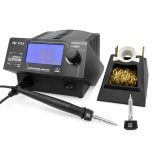
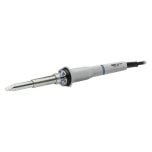
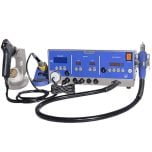
A good tip is what really transfers the heat - care and condition matter. More in Soldering tip care.
Frequently asked questions
Do more watts mean a hotter soldering tip?
No. The tip temperature is controlled and stays around 350 to 380 °C. More power only makes the station recover that temperature faster under load and hold it steady.
How many watts does a soldering iron need for electronics?
For standard electronics 60 to 90 W is enough. Fine SMD works with 40 to 80 W, while ground planes and thick wires call for 80 to 150 W.
Can I do fine soldering with a powerful station?
Yes. Power is a reserve, not a fixed operating point. With a fine tip and good control, a strong station solders clean SMD joints too.
The right soldering power for your task
From the fine station to a strong one for ground planes - with matching tips from a single source.
Reviewed
Content reviewed by soldering specialists.
Matching tips
Wide tip range for every task.
Controlled
Stations with stable tip temperature.
Selection help
We help you choose the right products; technical details are clarified with the manufacturer.