
Choosing a Pressure Gauge - Range, Class and Damping?
The right pressure gauge depends on measuring range, accuracy class, connection and damping. This guide shows how to set these four criteria to EN 837 and why glycerine filling matters for compressed air and hydraulics.
View pressure gaugesContents
Which measuring range does the gauge need?
The measuring range follows the operating pressure. To EN 837 the normal operating pressure should sit in the middle third of the scale: up to about 75 % of full scale under steady load and about 66 % under fluctuating load.
A full-scale value that is too high makes reading imprecise, while one too low overloads the measuring element. For a compressed air network at 6 to 8 bar a 0‑10 bar or 0‑16 bar gauge is typical, for hydraulics at 200 bar a 0‑250 bar or 0‑400 bar range.
- Compressed air FRL unit 6‑8 bar: scale 0‑10 bar or 0‑16 bar.
- Hydraulic test port 200 bar: scale 0‑250 bar or 0‑400 bar.
- Pulsating pressure: go one range larger to absorb the peaks.
- Vacuum or combined pressure: use a -1 to +X bar compound scale.
Which accuracy class do you need?
The accuracy class states the maximum deviation as a percentage of full scale. A 0‑16 bar class 1.6 gauge may therefore deviate by up to 0.256 bar. The smaller the number, the more accurate and more expensive the instrument.
Which connection and design suit the job?
Thread, position and case size must match the installation. Common threads are G 1/4 and G 1/2 to EN 837, usually as a radial bottom connection or an eccentric back connection for panel mounting.
- Connection position: bottom (radial) for pipe mounting, back (axial) for panels.
- Thread: G 1/8, G 1/4, G 1/2 or NPT - matched exactly to the fitting.
- Case diameter: 40‑63 mm compact, 100‑160 mm for easy remote reading.
- Material: brass for compressed air, stainless steel for hydraulic oil and corrosion.
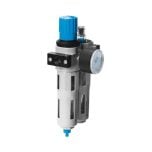
When does glycerine damping make sense?
A glycerine-filled gauge damps vibration and rapid pressure surges. The liquid slows the pointer so it stays steady despite pulsation and protects the movement. This clearly extends service life.
Typical cases are hydraulic pumps, compressors and test rigs where pressure pulses constantly. For a steady, vibration-free air display a dry gauge is enough. Glycerine is stable up to about 60 °C; at low temperatures a silicone-oil filling is often chosen instead.
Frequently asked questions
How large should the measuring range be?
Large enough that the operating pressure sits at about two thirds of the scale. To EN 837 no more than 75 % under steady and 66 % under fluctuating load, leaving headroom for peaks and keeping the reading accurate.
What does accuracy class 1.6 mean?
The maximum deviation is 1.6 % of full scale. On a 0‑16 bar scale that is about 0.26 bar. For a general compressed-air display that is accurate enough.
Do I always need a glycerine gauge?
No. Glycerine pays off with vibration and pulsating pressure, for example on pumps and compressors. For steady, vibration-free readings a dry gauge is fine.
Brass or stainless steel?
Brass is fine for clean compressed air. For hydraulic oil, aggressive media or harsh environments a gauge with a stainless-steel case and suitable movement is the better choice.
Looking for the right pressure gauge?
We supply pressure gauges for compressed air and hydraulics - dry or glycerine-filled, in every accuracy class and connection variant to EN 837.
Standard-tested
Gauges to EN 837-1 with a defined accuracy class.
Vibration-proof
Glycerine filling available for pulsating pressures.
Exact fit
Connection, range and design for every application.
Selection help
We help you choose the right products; technical details are clarified with the manufacturer.