
Choosing a Pneumatic Gripper: Parallel or Angular?
Pneumatic grippers turn compressed air into a defined grip force and handle workpieces in automated production. This guide explains the difference between parallel and angular grippers, how to size grip force with a safety factor, and what matters for stroke, jaws and end-position sensing.
View pneumatic grippersParallel or angular gripper - which fits?
A parallel gripper moves its jaws linearly toward each other and holds the workpiece by form fit or friction. An angular gripper opens the jaws through a swivel angle and suits cases where the jaws should swing clear of the part contour when releasing.
Parallel grippers are the standard for precise handling because the parallel guidance keeps a consistent grip position. Angular grippers win where there is little room for linear jaw travel or where parts must be released quickly. As a third design, the centric gripper uses three jaws to self-centre round parts.
How much grip force do you really need?
The required grip force follows from the workpiece weight, the friction between jaw and part, and the accelerations during motion. For a friction grip, the friction force must exceed the product of mass and the acting acceleration.
- Workpiece mass and centre of gravity set the static holding force.
- Acceleration and deceleration of the machine add dynamic forces, often several times the weight.
- The jaw friction coefficient (steel, serrated or with an insert) enters the calculation directly.
- Apply a safety factor of 3 to 4 to the calculated force.
- With a form-fit grip the jaw contour holds the part and the grip force only secures position.
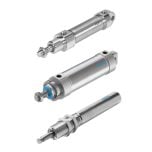 Compressed-air preparation
Clean, regulated pressure keeps grip force constant and protects the seals.
View productsWhat matters for stroke, jaws and sensing?
Beyond grip force, the stroke per jaw, repeat accuracy and end-position sensing decide how well a gripper suits automation. The jaw stroke must cover part tolerances plus a safe approach clearance.
- Design top jaws to suit the workpiece and keep them easy to swap.
- End-position sensors report open, closed and part-present to the control.
- Match size and interface so the gripper fits the robot flange.
Frequently asked questions
When to use parallel versus angular grippers?
The parallel gripper is the first choice for precise, form-stable handling. The angular gripper suits cases where the jaws must swing clear of the part contour when opening, or where space for linear motion is limited.
What safety factor should I apply to grip force?
A factor of 3 to 4 on the purely calculated holding force is common. It covers accelerations, friction variation and pressure fluctuations so the part stays secure even under dynamic loads.
Does the gripper hold if air pressure fails?
Only conditionally. Standard grippers open on pressure loss. For safe holding, choose versions with spring assist or mechanical self-locking that fix the part even without air.
Why does grip force drop with long jaws?
The rated force applies at the gripper piston. Long jaws act as a lever and increase the moment on the guidance, so the usable force at the workpiece decreases.
Looking for the right pneumatic gripper?
We supply parallel, angular and centric grippers in various sizes, matched to your workpiece and cycle time.
Correctly sized
Grip force calculated for your part with a safety factor.
Every design
Parallel, angular and centric grippers from stock.
Automation-ready
With end-position sensing and standard interfaces.
Selection help
We help you choose the right products; technical details are clarified with the manufacturer.