
Valves
Pressure valves
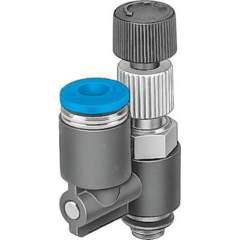
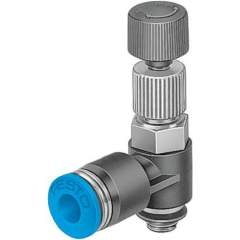
Festo pressure valves in the LRL and LRLL series are differential pressure control valves that regulate the pressure at a load to a constant value below the supply pressure. LRL valves have a single supply; LRLL valves add a leakage line (exhaust port) for more precise regulation at very low differential pressures. 24 articles span port sizes from M5 and G 1/8 to G 1/2, each combined with QS push-in ports for 4 to 12 mm tubing.
- 24 items
- 1 manufacturer
- Net prices plus VAT
Buying guide
How to choose Pressure valves
What matters when choosing: properties, comparison and typical applications.
Series and ports
| Series | Port | Feature |
|---|---|---|
| LRL-M5-QS-4 | M5 + QS-4 | Miniature format for 4 mm tubing |
| LRL-M5-QS-6 | M5 + QS-6 | Miniature format for 6 mm tubing |
| LRL-1/8-QS-4 to QS-8 | G 1/8 + QS 4-8 mm | Standard format, small nominal sizes |
| LRL-1/4-QS-6 to QS-10 | G 1/4 + QS 6-10 mm | Standard format, medium nominal sizes |
| LRL-3/8-QS-8 to QS-12 | G 3/8 + QS 8-12 mm | Larger nominal sizes |
| LRL-1/2-QS-12 | G 1/2 + QS-12 | Largest version |
| LRLL (all sizes) | As LRL + leakage line | Higher regulation accuracy, exhaust port present |
Selection notes and LRL vs. LRLL difference
LRL valves suit standard applications where pressure deviations of a few hundred mbar are acceptable. LRLL valves with a leakage line achieve higher control accuracy since outlet pressure changes are corrected more rapidly. The QS push-in variant (e.g. LRL-1/4-QS-10) combines a G 1/4 thread on one side with a push-in fitting for 10 mm tubing on the other. M5 variants suit miniature cylinder applications. Pressure is set via the adjustment screw; the control range should be limited to the system pressure.
Typical applications
Typical applications: Individual cylinder pressure limiting in clamping systems, zone-by-zone pressure reduction for different gripping and clamping forces, differential pressure control on test rigs (reference pressure vs. system pressure), protection of pressure-sensitive loads such as seals and miniature grippers, and pneumatic force limiting in manually assisted assembly processes.